
Emissions Dip, but Not for the Reason Many Hoped
A new projection says fossil-fuel CO2 may fall in 2026, but war-driven oil prices appear to be the main cause.
Print it — all four files
The student packet has no answers in it. The teacher copy is the same pages plus a note on each question and the answer keys. Both languages carry the same story, the same picture and the same vocabulary.
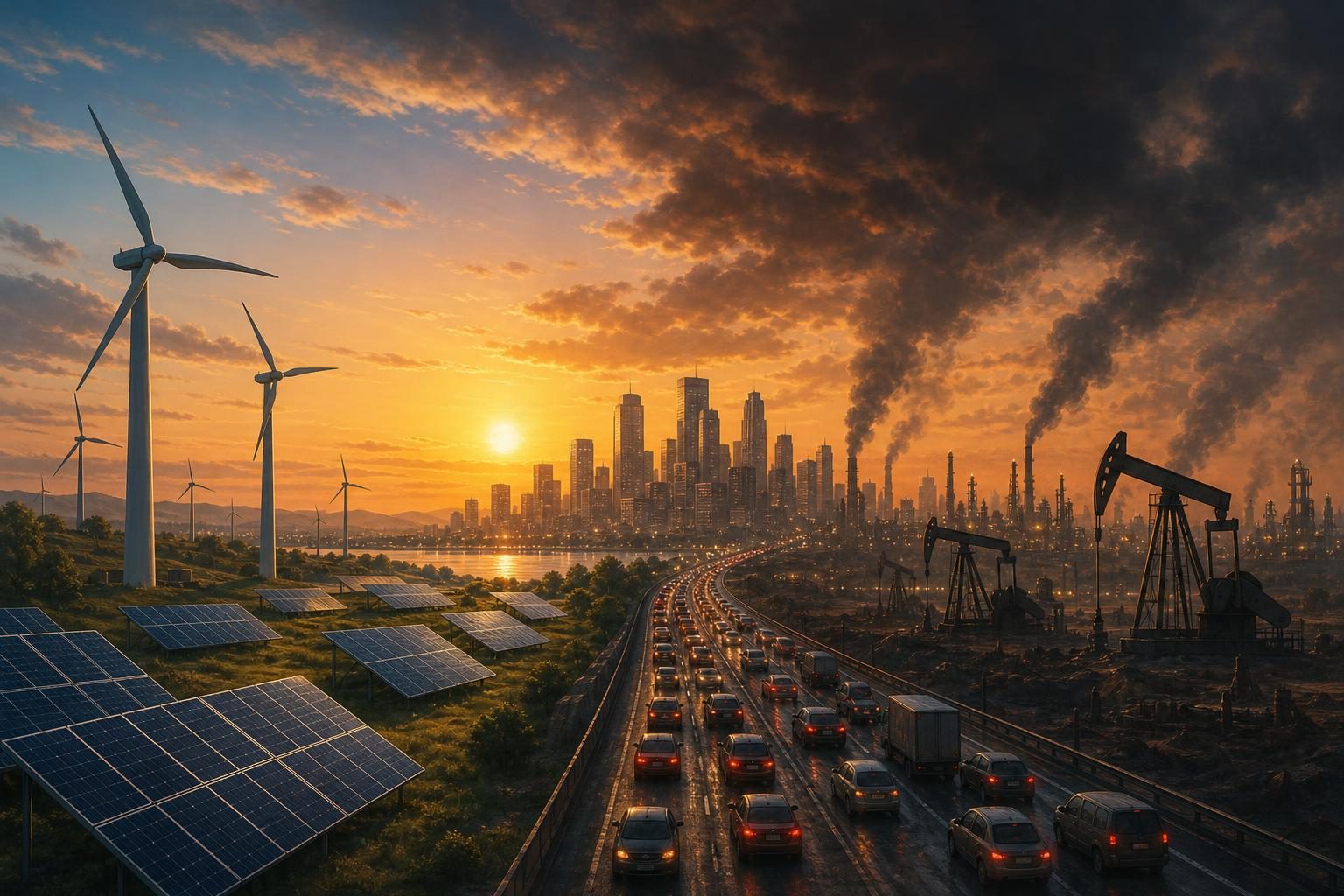
Global carbon dioxide emissions from fossil fuels are expected to fall slightly in 2026, according to Science News, which reported on a new study published November 9 in Nature Climate Change. That sounds like good climate news at first: carbon dioxide is the main heat-trapping gas released when coal, oil and natural gas are burned, and cutting those emissions is central to slowing climate change. But the study’s main warning is that the drop may not mean the world has finally turned the corner.
The researchers project that fossil-fuel carbon dioxide emissions will decrease by 0.4 percent this year. From 2019 to 2025, those emissions had grown by an average of 0.8 percent per year. In other words, the direction has changed, but only a little. The projected total for 2026 is 38.24 gigatons of carbon dioxide. A gigaton is one billion metric tons, a scale used for global climate pollution because the numbers are so large. That 2026 total would be about 0.16 gigatons lower than in 2025.
The reason matters. The researchers say the dip was probably driven by high oil prices linked to the Iran war, not mainly by a sudden acceleration in clean energy. Higher oil prices can reduce fuel use because driving, shipping, flying and some forms of manufacturing become more expensive. That can lower emissions, but it can also hurt households and businesses. A decrease caused by an energy shock is different from a decrease caused by replacing polluting systems with cleaner ones.
That is the central tension in the story. Climate goals require emissions to fall, but not all ways of making emissions fall are equally stable or fair. A war-related price spike may reduce oil use, but it is not a climate policy, and it may not last. If prices fall again or economies adjust, emissions could resume rising. By contrast, building more wind and solar power or replacing gasoline cars with electric vehicles changes the energy system itself. Those changes can keep reducing emissions after one unusual year has passed.
The study does not say clean energy is failing. It says the current pace is not yet enough to push global emissions consistently downward on its own. The researchers estimated that electric vehicles, solar power and wind power are already having a large effect. Without those technologies, global emissions would have risen by an average of 1.9 percent per year from 2019 to 2025, according to the study. That means clean energy is slowing the climb even if it has not yet produced a steady global decline.
The study also looks ahead. If electric vehicle sales and wind and solar capacity continue growing at their 2026 rates, those technologies should counteract about 63 percent of the growth in emissions from 2025 to 2028. Put another way, they could help avoid about 1.64 gigatons of additional carbon dioxide. An electric vehicle runs on electricity instead of gasoline or diesel, and its climate impact depends partly on how that electricity is produced. Solar and wind power generate electricity without burning fossil fuels during operation.
There is another interesting detail in how the study was done. The research team used data on countries’ electric vehicle stocks and wind and solar generation to project the technologies’ effects through 2028. Science News reports that the team also used Claude, a generative artificial intelligence model, to help find data and write code for the analysis. Generative AI is software that can produce text, computer code or other outputs from prompts. Its use may speed research, but it also raises questions about checking sources and methods carefully, because AI tools can make mistakes even when their answers sound confident.
For policymakers, the difficult question is what lesson to take from a year like this. One tempting conclusion is that emissions are finally falling, so current efforts are enough. The study points in the opposite direction: the decrease appears partly accidental, and the clean-energy transition still needs to accelerate if the world wants repeated annual declines. Energy transition means the long-term shift from coal, oil and gas toward lower-carbon sources such as wind and solar.
At the same time, the numbers show why some climate experts argue that the world is close to a turning point. The technologies that reduce emissions are no longer tiny. They are large enough to cancel out much of the growth that would otherwise happen. The dispute is about speed and reliability: whether governments, companies and consumers are moving quickly enough for emissions to peak and then fall year after year.
Peak emissions means the highest point before a lasting decline. Glen Peters, a climate scientist involved in the research, told Science News that it is hard to say exactly when humanity will reach that point, but the fact that researchers are now debating it suggests the world is near. The 2026 dip may be a sign of progress, a warning about fragile progress, or both at once.
Written from reporting by Science News, “Fossil fuel emissions are down in 2026. Green energy isn’t the reason”.
Discussion questions
- Should a war-related drop in oil use be counted as climate progress, or only as a temporary side effect? Defend your view.
- If clean energy is already slowing emissions growth but not yet causing a steady decline, what should governments prioritize: faster technology deployment, reducing demand for fossil fuels, or protecting people from high energy prices?
- How should readers judge research that uses generative AI to help find data or write code, and what safeguards would make that use more trustworthy?