
The UN’s Next Leader Faces a Job Built on Limits
The search for a new secretary-general raises a hard question: what kind of leader can guide an organization that cannot simply order countries around?
Print it — all four files
The student packet has no answers in it. The teacher copy is the same pages plus a note on each question and the answer keys. Both languages carry the same story, the same picture and the same vocabulary.
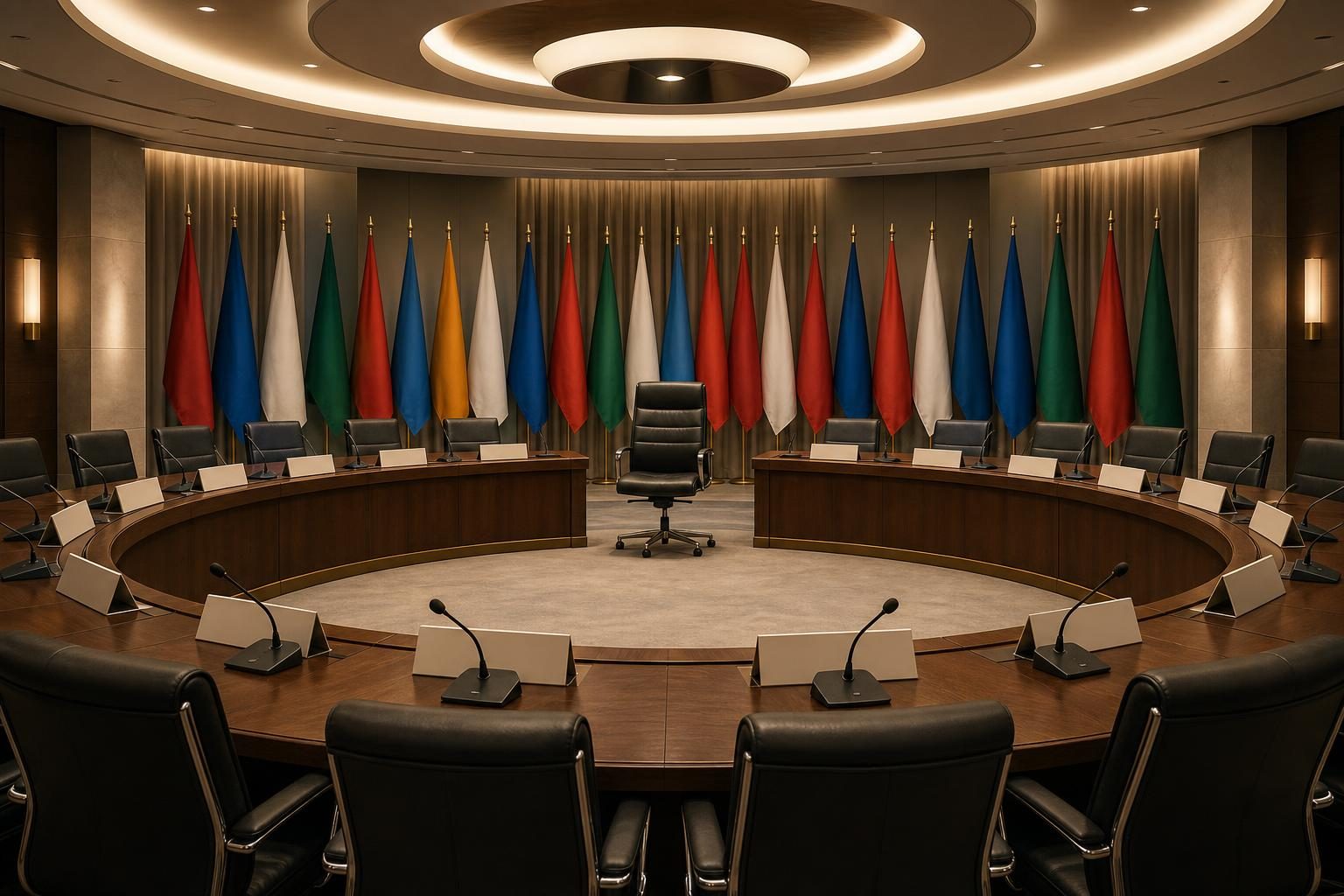
The race to choose the next United Nations secretary-general is underway, according to reporting published by PBS NewsHour from the Council on Foreign Relations. The winner is expected to take office on Jan. 1, 2027, replacing António Guterres and becoming the 10th person to hold the job since the UN was created after World War II.
The choice matters because the UN is entering another difficult period. The article describes an 81-year-old organization facing severe funding shortages, demands for internal reform, worsening climate change, the spread of artificial intelligence, and rising tensions among powerful countries. The secretary-general does not rule the world, but the office can shape what problems get attention, how crises are framed, and whether governments feel pressure to act together.
The secretary-general is the UN’s chief administrative officer, meaning the person responsible for managing the organization’s work. The role is also often treated as the public face of the UN system. That creates a built-in tension. The officeholder is expected to speak for international cooperation, but the UN is made up of member states, meaning countries that have their own governments, interests, rivalries, and limits. A secretary-general can urge, warn, negotiate, and organize. They cannot simply command nations to follow an agenda.
That is why the selection is not just a résumé contest. The PBS/Council on Foreign Relations article notes that experts see the job as both weak and influential. Its influence depends partly on the person’s skill, partly on whether governments accept the person’s priorities, and partly on whether global public opinion gives the officeholder room to push. In other words, the next secretary-general must be persuasive in a system where persuasion may be the main tool available.
This year’s race also carries a representation question. The article says seven candidates are currently running, four of them women, which means the UN could choose its first woman secretary-general. It also says there is a strong possibility that the next leader could come from Latin America and the Caribbean, based on an informal regional rotation. Informal means it is not a strict written rule; it is a practice that has developed over time to spread leadership among different parts of the world.
That creates a real debate, not a simple one. Choosing the first woman to lead the UN could matter symbolically and practically, especially for an organization that often speaks about equality. Selecting someone from Latin America and the Caribbean could also answer concerns that global leadership has too often reflected the preferences of a few powerful states or regions. But the next leader will also inherit problems that require management skill, diplomatic judgment, and credibility with governments that may disagree sharply with one another. The question is not whether representation matters or experience matters. It is how much weight each should carry when the job itself is so constrained.
The candidates described in the article include former foreign ministers, ambassadors, UN officials, and leaders of international agencies. Their pitches focus on themes such as preventing wars, reforming the UN Security Council, rebuilding trust in the institution, improving development efforts, and making the organization more results-driven. Those phrases point to another tension: the UN is often criticized for not delivering enough, but many of its failures come from disagreement among the countries that control its authority and funding. A secretary-general may promise reform, but reform usually requires cooperation from the same governments that may benefit from the current system.
The selection process itself adds to the stakes. The UN Charter, the document that created the organization, describes the secretary-general’s role but does not spell out detailed qualifications, the desired qualities of the leader, the length of service, or a full selection process. Over time, the UN has filled in some expectations through resolutions and other documents. That flexibility may allow the organization to adapt to new problems. It can also make the process feel less transparent than a normal public hiring decision.
Supporters of flexibility might argue that a rigid checklist would be a mistake. The world of 2027 is not the world of 1946, when the first secretary-general was appointed. Climate change, artificial intelligence, and today’s geopolitical tensions require different skills from those needed in earlier decades. A broad process could allow governments to choose someone suited to the moment.
Critics might answer that unclear rules can protect old power arrangements. If the public cannot easily see what qualifications matter most, it becomes harder to judge whether the best candidate was chosen or whether the outcome mainly reflected behind-the-scenes bargaining. For an institution already worried about credibility, the way the leader is chosen can affect how much trust that leader has on day one.
The next secretary-general will not solve the UN’s problems alone. The office is too limited for that. But the choice will still signal what the UN’s members think the organization most needs: a reformer, a mediator, a manager, a moral voice, a breakthrough in representation, or some combination of all of these. The trade-off is that no candidate can perfectly represent every priority at once.
Written from reporting by PBS NewsHour, “Who will be the UN's next secretary-general? What to know about the selection process”.
Discussion questions
- Should the UN give special weight to choosing its first woman leader or a leader from an underrepresented region, even if another candidate is seen as more experienced in crisis management? Defend your position.
- Is a leader with limited formal power but a major public platform more likely to be effective or ineffective in international politics? Explain using the secretary-general’s role.
- Would the UN be better served by a clearer, more rule-based selection process, or by keeping the process flexible? Why?