
U.S. Pushes for More Spaceports as Launches Surge
A new federal policy aims to make room for many more rocket launches, raising questions about speed, safety, land use, and public oversight.
Print it — all four files
The student packet has no answers in it. The teacher copy is the same pages plus a note on each question and the answer keys. Both languages carry the same story, the same picture and the same vocabulary.
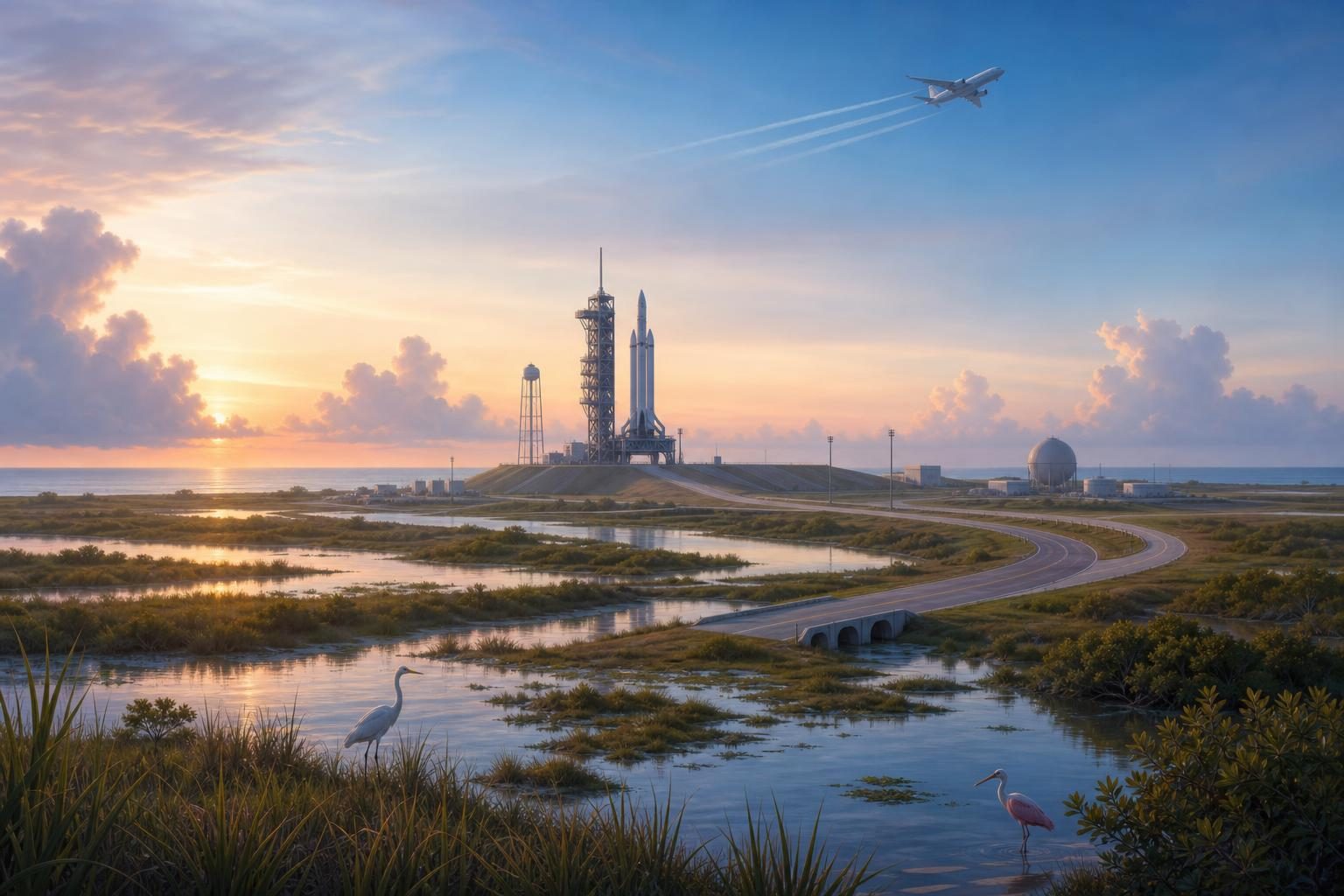
President Donald Trump signed a new national space transportation policy Thursday that calls for expanding the United States’ ability to launch rockets and bring spacecraft back to Earth, according to reporting by Ars Technica. The policy says the country should be ready to handle more than 1,000 launches and reentries per year by 2030. A reentry is the return of a spacecraft, capsule, or rocket stage from space into Earth’s atmosphere.
The policy replaces one signed in 2013 by President Barack Obama. Both policies support commercial spaceflight, meaning launches run by private companies rather than only by government agencies. But the scale has changed dramatically. Ars Technica reports that there were 176 orbital launch attempts from U.S. soil last year, nearly 10 times the number in 2013. An orbital launch is a launch meant to place something, such as a satellite, into a path around Earth. SpaceX accounted for most of those launches, with 165 Falcon 9 orbital launches, plus five suborbital test flights of its much larger Starship rocket. Suborbital means the vehicle reaches space or near-space but does not complete an orbit around Earth.
The new policy is built around a simple pressure point: more people want to use space, and the current system may not have enough room. The expected demand comes from both business and the military. The article lists communications services, overhead surveillance, space-based targeting, and orbital data centers as reasons launch traffic could grow. Overhead surveillance means using satellites to observe Earth from above. Space-based targeting refers to using space systems to help locate or track objects for military purposes. Orbital data centers are a still-developing idea: computer facilities placed in orbit instead of on the ground.
A spaceport is a launch and landing site for rockets and spacecraft, much like an airport is a takeoff and landing site for aircraft. The major federal spaceports now include Cape Canaveral Space Force Station and NASA’s Kennedy Space Center in Florida, Vandenberg Space Force Base in California, and NASA’s Wallops Flight Facility in Virginia. Only the Florida and California sites are now equipped for heavy-lift launches, which use large rockets capable of carrying especially heavy payloads into space.
The policy tells the Pentagon and NASA to coordinate infrastructure investments at federal launch and reentry ranges. A range is the controlled area used for launches, tracking, safety systems, and recovery operations. It also supports more efficient scheduling at federal spaceports and calls for range schedules to be published regularly. That would be a change from the current practice, in which many launch schedules are not public until days or weeks before launch.
The government also plans to look for locations for additional launch facilities in the United States. One part of the policy directs the Department of the Interior to identify federal lands that could serve as an additional federal land reentry site. Federal lands are areas owned or managed by the national government. Last month, the Interior Department’s Bureau of Ocean Energy Management also asked for public comment on whether submerged lands and abandoned offshore oil rigs could be used for sea-based launches and reentry operations.
The case for expansion is not only commercial. The policy appears to match the direction of a recent Pentagon study, described in a House Armed Services Committee hearing, that found the United States may need a third heavy-lift launch site. Air Force Secretary Troy Meink said in May that the country likely needs another site for heavy and super-heavy launches both for capacity and for resiliency. In this context, resiliency means not relying too heavily on only one or two places that could be disrupted by weather, accidents, conflict, or overcrowding.
That is the strongest argument for the policy: if rockets are becoming part of everyday communication, military planning, science, and industry, then bottlenecks at a few launch sites could become a national weakness. A delayed launch might mean a delayed satellite, a delayed mission, or less flexibility in an emergency. The policy also calls for more responsive launch operations, including the ability to send high-priority payloads into orbit within 48 hours of need, possibly from temporary or expeditionary locations away from traditional launch ranges.
The trade-off is that speed and capacity are not the only public values involved. More launches can affect air traffic because aircraft may need to avoid launch corridors, which are protected paths through the sky. More spaceports can also raise questions about land use, environmental review, noise, public access, coastal waters, and who benefits from public infrastructure. The article notes that the government is already pursuing faster permitting and environmental reviews, as well as more access for commercial users at federal ranges and user fees for companies operating from NASA or military spaceports.
That creates the central tension. The administration wants a launch system that can grow quickly enough to match commercial and military demand. But the faster the system grows, the more important it becomes to decide who gets priority, how much private companies should pay for public facilities, how transparent scheduling should be, and how carefully new sites should be reviewed before they are built. The policy answers one question clearly: the United States wants more room for spaceflight. It leaves many of the hardest choices to the agencies, communities, companies, and regulators that will have to make that room real.
Written from reporting by Ars Technica, “Trump's space transportation policy calls for new spaceport on federal land”.
Discussion questions
- If the United States needs more launch capacity, what should matter most when choosing new spaceport or reentry sites: national security, economic growth, environmental review, local impact, or speed?
- Should private space companies get expanded access to federal launch facilities if demand keeps rising, or should government missions receive clear priority?
- The policy calls for faster permitting and environmental reviews. When, if ever, is it justified to speed up review processes for major infrastructure?