
Who Gets to Run a Federal Election?
A Justice Department lawsuit in Alaska raises a bigger fight over state power, federal oversight and election trust.
Print it — all four files
The student packet has no answers in it. The teacher copy is the same pages plus a note on each question and the answer keys. Both languages carry the same story, the same picture and the same vocabulary.
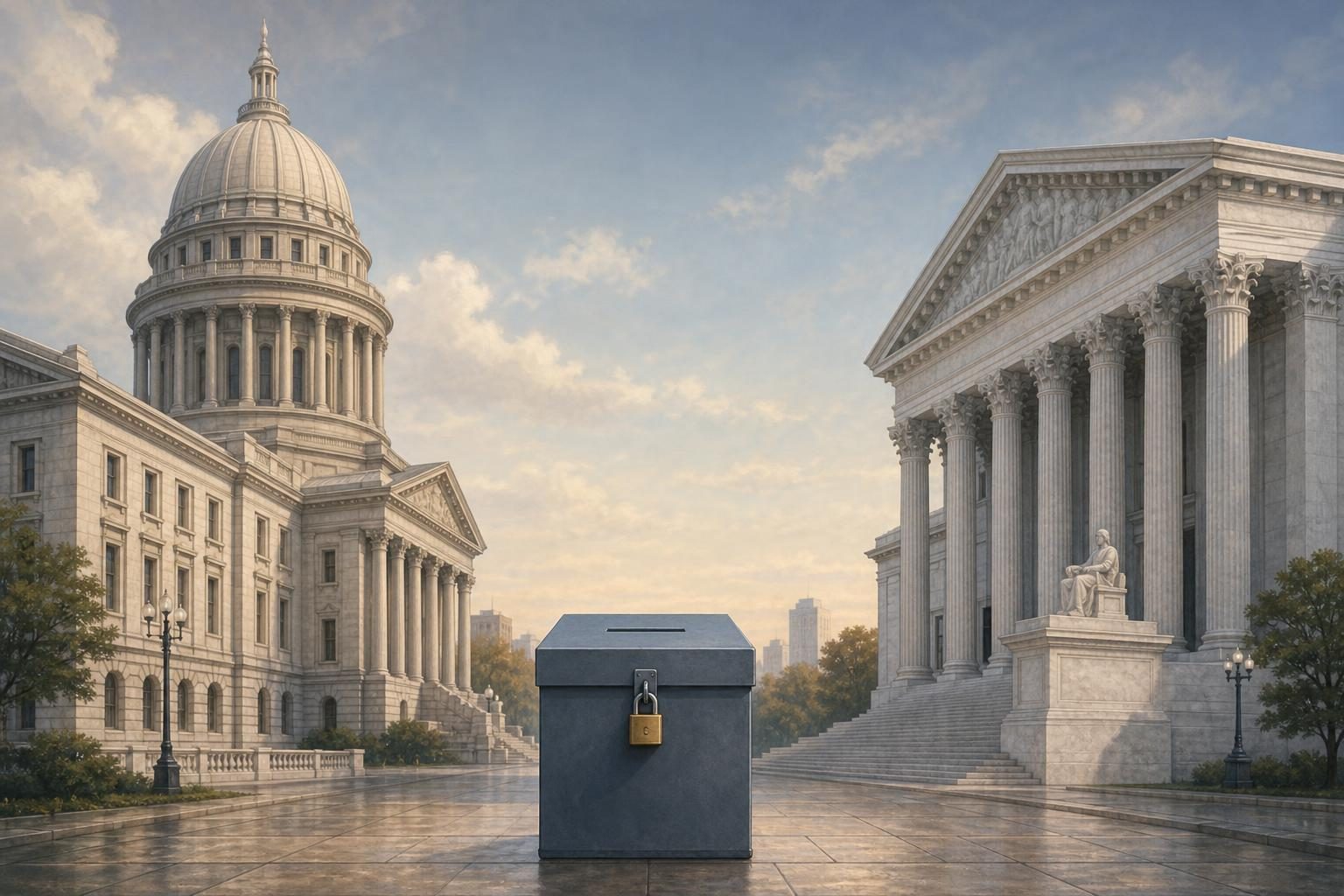
The Trump administration has sued Alaska over its U.S. Senate election, asking a court to stop the state from certifying, or officially confirming, the result if the Republican incumbent does not win. According to legal analysis published by The Conversation, the U.S. Department of Justice says it is trying to protect election integrity because another candidate on the ballot has a very similar name to the incumbent senator. The department argues that if the incumbent loses, voter confusion may have affected the outcome and Alaska should investigate before making the result final.
The case matters beyond one state because it tests a basic design choice in American government: federal elections choose national officials, but states usually run the elections. The Constitution gives states the power to set the time, place and manner of federal elections, while Congress has limited power to change those rules. The presidency is not given that job. That division is part of federalism, the system in which power is split between state and national governments rather than held in one place.
The Justice Department’s position is that the federal government has a responsibility to protect the integrity of elections for federal office. Election integrity means making sure that eligible voters can vote, ineligible votes do not count and the final result reflects the voters’ choices. In the Alaska lawsuit, the department’s concern is not a voting machine or a ballot count, but whether voters might choose the wrong person because two names are similar. The remedy it seeks is unusual: if the incumbent Republican senator loses, the state should not certify the election until it conducts an inquest, meaning an official inquiry, into what voters intended.
The Democratic candidate’s campaign strongly rejects that argument. In court filings described by The Conversation, the campaign says the lawsuit has no legal basis and would improperly throw out or delay the choice made by Alaska voters. Its basic objection is that the federal government is trying to interfere before the election is even over, and only under one condition: if a particular candidate loses. That is why the case is not just about ballot design. It is also about whether a legal challenge meant to prevent confusion could itself become a tool for changing the effect of an election.
Legal experts cited by The Conversation argue that the Constitution’s structure leaves election administration mainly to the states unless Congress acts within its authority. Former federal judge John E. Jones, now president of Dickinson College, said earlier this year that states were trusted to run elections because they already had the systems to do so and because the framers did not want one national executive controlling the process. The concern is not only historical. If one politically motivated official could control elections everywhere, the power could be abused.
That does not mean states can do anything they want. Congress can pass laws about federal elections within constitutional limits, and courts can step in when state practices violate federal rights. For example, federal law protects against racial discrimination in voting, and courts can enforce equal protection rules when voters are treated unfairly. The harder question is where oversight ends and control begins. Supporters of stronger federal action often argue that national elections need consistent standards and protection against fraud or confusion. Critics answer that concentrating election power in Washington, especially in the executive branch, creates its own danger.
The Alaska case follows other 2026 conflicts over who controls election rules. The Conversation points to a March executive order in which President Trump sought to change how mail voting works by directing federal agencies, including the U.S. Postal Service, to impose requirements on mail and absentee ballots. An executive order is an instruction from the president to federal agencies, but it cannot create powers the Constitution does not give the president. Legal scholars cited by The Conversation argued that using the postal system to block ballots that did not meet new federal conditions would effectively cancel some votes by administrative action.
Another example was the SAVE America Act, passed by the Republican-controlled House but not by the Senate. It would have required documentary proof of U.S. citizenship for some voter registration and voting in federal elections. Documentary proof means official papers, such as a passport or birth certificate, rather than simply signing a statement. The stated goal was to prevent noncitizen voting. The constitutional objection, according to election law scholar John J. Martin, was that voter qualifications are generally set by states, not Congress. The Senate’s refusal to pass the bill means that fight has not reached the courts in that form.
The real tension is that both sides are arguing from principles many Americans value. It is reasonable to want elections protected from fraud, confusion and mistakes. It is also reasonable to worry when the federal executive branch asks to delay or block a state’s result based on a condition tied to who wins. A system that is too decentralized can produce uneven rules and messy disputes. A system that is too centralized can make elections easier for one powerful office to pressure.
The Alaska lawsuit puts that tension into a concrete form. If courts allow the federal government to intervene before certification because it predicts voter confusion, that could create a new path for challenging close or unwanted results. If courts reject the lawsuit, they reinforce the idea that election problems should usually be handled by states, Congress or post-election court challenges based on evidence. Either way, the case asks a question that sounds simple but is not: in a national election run through state systems, who gets the final say before the voters’ choice becomes official?
Written from reporting by The Conversation, “What legal experts say about the Trump administration’s attempts to make a federal case out of state elections”.
Discussion questions
- When, if ever, should the federal government be able to stop a state from certifying an election result before it becomes official?
- Is voter confusion a strong enough reason to delay an election result, or should officials require clearer evidence that confusion actually changed votes?
- Which danger seems greater in this situation: uneven state-run elections or too much election power in the hands of the national executive branch?