
Free activities › Middle school
A Pennsylvania Canyon Shows How Ice Can Shape a Forest
A new NASA satellite image highlights Pine Creek Gorge, where glaciers changed a river and a damaged forest grew back.
Print it — all four files
The student packet has no answers in it. The teacher copy is the same pages plus a note on each question and the answer keys. Both languages carry the same story, the same picture and the same vocabulary.
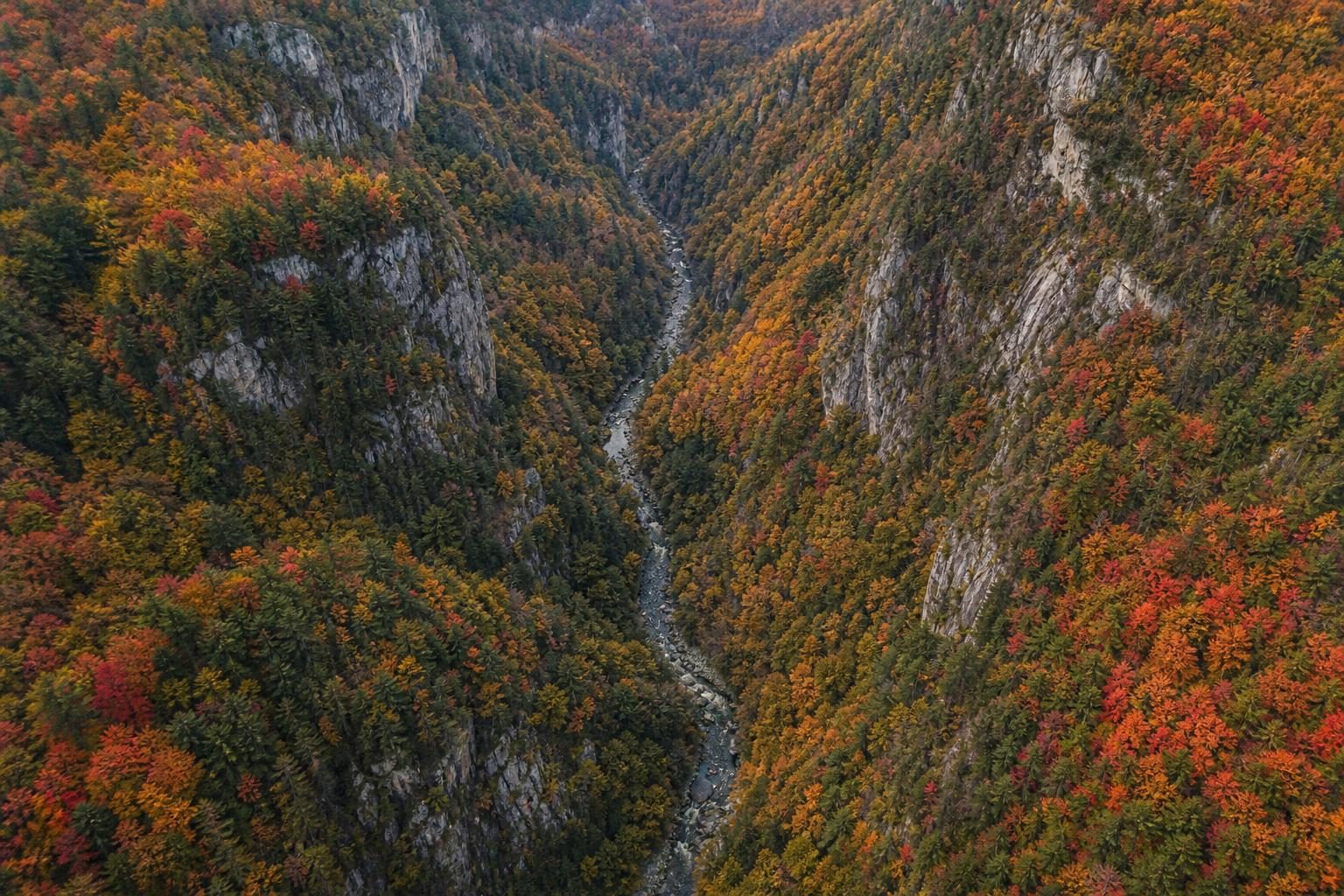
NASA’s Earth Observatory released a new satellite view of Pine Creek Gorge in north-central Pennsylvania, taken on October 25, 2026, when fall colors were bright across the forest. The image shows a deep canyon-like valley cutting through the Allegheny Plateau, a broad raised area of land. It is a reminder that Earth’s surface is still a storybook, if people know how to read the clues.
Pine Creek Gorge is often called the Grand Canyon of Pennsylvania. According to NASA’s Earth Observatory, the gorge reaches about 1,500 feet deep in some places and runs about 45 miles. Unlike many canyons in the dry Southwest, this one does not have mostly bare rock walls. Its slopes are covered with trees, including northern hardwoods, mixed oak forest, hemlock, and white pine.
The new image was taken by the Operational Land Imager, a camera-like tool on the Landsat 8 satellite. Landsat 8 is a NASA and U.S. Geological Survey satellite, which means it orbits Earth and takes repeated pictures from space. Scientists use images like this to study forests, rivers, farms, fires, cities, and changes in land over time.
The gorge matters because its shape was strongly affected by glaciers, which are huge, slow-moving masses of ice. During the last ice age, glaciers moved into the region from the northeast. The ice did not scrape out the canyon directly. Instead, it blocked Pine Creek, which once flowed north. Water backed up into lakes, then overflowed and began rushing south.
After the ice melted back, Pine Creek kept flowing south. Rocks and sand left by the melting glaciers helped stop the creek from turning north again. Glacial meltwater, or water from melting ice, continued to cut deeper into the valley. Over time, that helped shape the gorge seen today. This is a good example of cause and effect in geology: one change in a river’s path can shape a landscape for a very long time.
The story is also about people. In the early 1800s, demand for wood products grew in the United States. Loggers cut many of the large trees around Pine Creek Gorge. White pine was valued for ship masts, and hemlock bark was used to tan leather, a process that turns animal hides into usable leather. Before railroads, logs were floated down Pine Creek toward the Susquehanna River.
By the early 1900s, decades of logging had left the area so bare that it became known as the Pennsylvania Desert. That name may sound strange for a wet, wooded place, but it shows how much the land had changed. Today the forest has returned. NASA notes that animals such as black bears, coyotes, bobcats, timber rattlesnakes, and many songbirds now live around the gorge.
In 1968, about 30,000 acres of the area were named a National Natural Landmark, a federal recognition for places with important natural features. People can visit parts of the gorge from state parks and the Pine Creek Rail Trail. The satellite image does not just show pretty fall leaves. It shows how ice, water, forests, and human choices can all leave marks on the same landscape.
Written from reporting by NASA, “Pennsylvania’s Grand Canyon”.
Discussion questions
- Which force seems more important in this story: natural change, such as glaciers and rivers, or human change, such as logging? Defend your answer.
- Satellite images can make landscapes easier to study, but they cannot show everything. What important parts of Pine Creek Gorge’s story might be missing from a view from space?
- If a damaged natural area can recover over time, should that change how people make decisions about using forests today? Why or why not?