
Free activities › Middle school
Curiosity Gets Ready to Drill a Strange Martian Rock
NASA’s rover is studying crystal-shaped textures that may hold clues about Mars’s past environment.
Print it — all four files
The student packet has no answers in it. The teacher copy is the same pages plus a note on each question and the answer keys. Both languages carry the same story, the same picture and the same vocabulary.
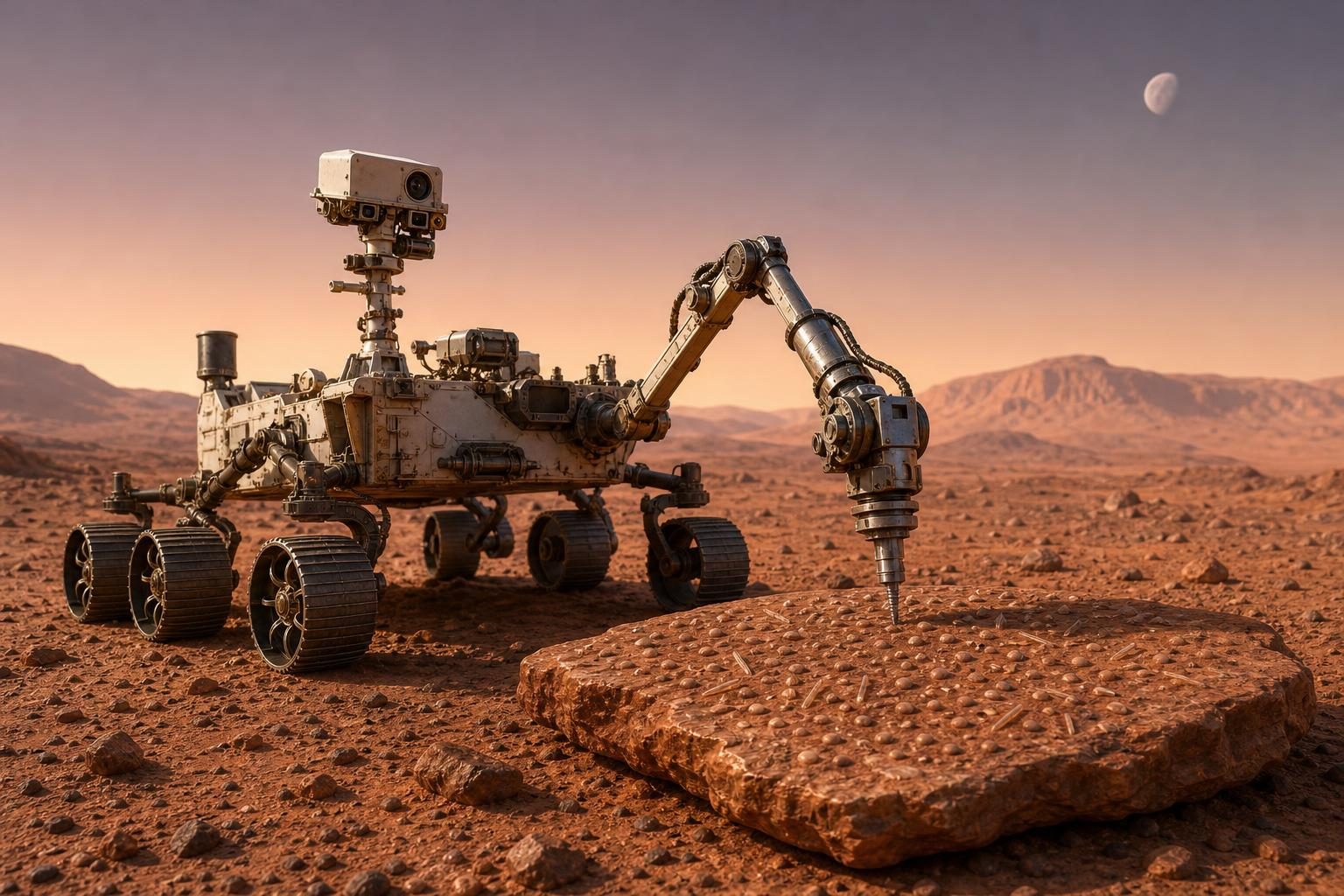
NASA’s Curiosity rover is getting ready to drill a Martian rock site named “Nazca,” according to NASA’s Curiosity mission blog. Curiosity is a rover, a robotic vehicle that can drive across another world and use science tools there. The team chose Nazca after nearby rock showed many small disc- and needle-shaped lumps. Another nearby target, called “Chiu Chiu,” had the same kind of texture, but it was not a good place to drill.
This matters because rocks can keep records. On Earth, geologists study rocks to learn about ancient lakes, volcanoes, deserts, and oceans. On Mars, scientists use Curiosity’s cameras, drill, and chemistry tools to ask a similar question: what was this place like long ago? The strange shapes at Nazca may be clues about minerals, salts, fluids, and temperature in Mars’s past.
One idea is that the discs and needles began as crystals. A crystal is a solid whose tiny particles are arranged in an orderly pattern, which can make it grow into certain shapes. Table salt can form cube-shaped crystals, for example. NASA says the large crystal-like forms at Nazca and Chiu Chiu may help scientists understand the conditions when they grew, including how warm the area was and whether salty fluids were present.
But the story may not be simple. The rock’s shape today may not match the material that first formed it. Sometimes one mineral can take the place of another while keeping the old shape. Scientists call that a pseudomorph, which means a “false form”: it looks like the original crystal shape, but its composition and inner structure have changed. That is why Curiosity needs more than a photo. The rover has to test what the rock is made of.
Before drilling, the team planned several careful checks. Curiosity’s close-up camera, called MAHLI, will take overlapping images from slightly different angles. Scientists can combine those images to build a three-dimensional model, meaning a model with height, width, and depth. That can show the raised and lowered parts of the crystal shapes in detail.
Curiosity will also use ChemCam, an instrument that studies chemistry with a laser. A laser is a narrow, powerful beam of light. For one nearby target called “Toucan,” ChemCam will fire all 150 laser shots at the same spot. Each shot vaporizes, or turns into gas, a tiny bit of rock and makes a plasma, which is a very hot glowing gas. By focusing the shots in one place instead of spreading them out, scientists expect to study rock about five times deeper than usual for that kind of measurement.
That depth matters because the surface of a Martian rock has been exposed to today’s Martian environment. The inside may tell a different story. If the deeper material is different from the surface, scientists may learn whether the rock changed after it formed or whether the crystal-like shapes grew under special conditions.
Curiosity is also watching Mars’s sky. NASA says twilight cloud season is beginning, and the rover will take nighttime images of Phobos, the larger and brighter of Mars’s two moons. When Phobos is full, sunlight reflected from it can scatter in the Martian atmosphere. That scattered light can help scientists estimate the sizes of particles in high-altitude carbon dioxide clouds. Carbon dioxide is the gas people breathe out, and on Mars it can also freeze or form clouds.
A drill site on Mars is not just a hole in a rock. It is a chance to connect chemistry, geology, weather, and engineering. Curiosity cannot bring a whole classroom to Mars, but it can bring back measurements that help people read the planet’s history, one careful test at a time.
Written from reporting by NASA, “Curiosity Blog, Sols 5043-5049: Preparing to Drill at ‘Nazca’”.
Discussion questions
- When scientists study a rock on Mars, why might shape alone be misleading evidence?
- Curiosity’s team spends time taking images and chemistry readings before drilling. Is that caution worth the delay?
- How is Curiosity’s work like what geologists do on Earth, and how is it different?