
Free activities › Middle school
A Space Photo Turns an Island Silver
A rare sunglint over Rennell Island shows how light can reveal—and hide—clues about Earth.
Print it — all four files
The student packet has no answers in it. The teacher copy is the same pages plus a note on each question and the answer keys. Both languages carry the same story, the same picture and the same vocabulary.
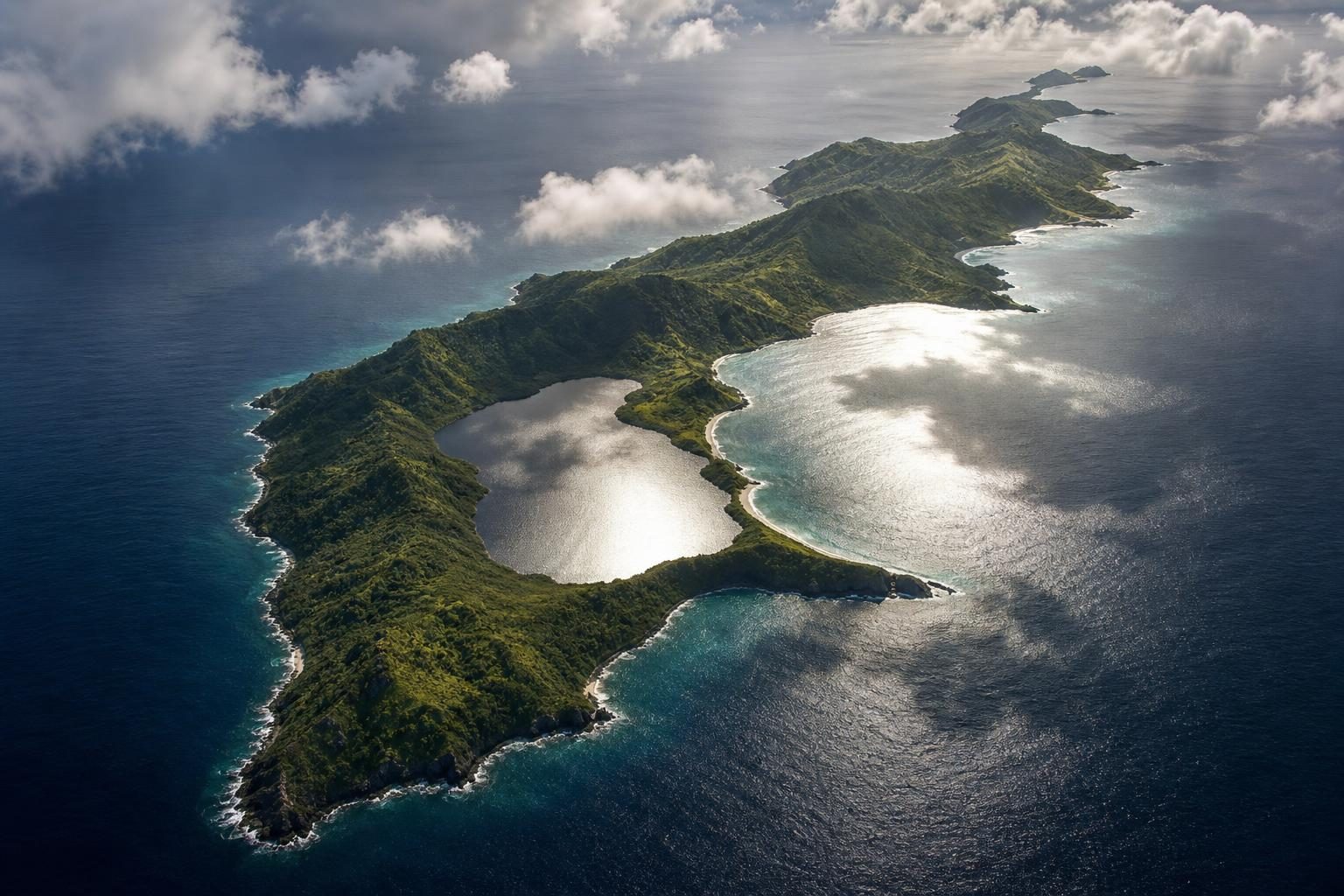
An astronaut on the International Space Station, a science laboratory that orbits Earth, photographed Rennell Island in the Pacific Ocean looking almost silver. According to Live Science, the effect was caused by a sunglint, which happens when sunlight bounces off water at just the right angle and shines straight into a camera. In the image, both the ocean and the island’s large lake reflect the light, making the water look metallic instead of blue.
Rennell Island is part of the Solomon Islands, an archipelago, or chain of islands, between Australia, Papua New Guinea, and Fiji. The Solomon Islands include nearly 1,000 islands, atolls, and reefs. Rennell is long and narrow, reaching up to 50 miles long and 8 miles wide. At its southeastern end is Lake Tegano, also called Lake Te Nggano. The lake covers about 60 square miles and is brackish, meaning its water is partly salty and partly fresh. According to Britannica, it is the largest lake on any Pacific island.
The photo looks unusual because calm water acts a little like a mirror. NASA’s Earth Observatory says the brightest parts are on the left side of Lake Tegano and in a horseshoe-shaped bay along the island’s lower edge. Those spots are sheltered from wind, so their surfaces are smoother. Smooth water reflects sunlight more strongly than choppy water. Cloud shadows scattered across the bright ocean make the scene look even more three-dimensional.
A sunglint is not just pretty. It can help scientists notice oceanographic features, which are patterns or objects in the ocean. When sunlight turns the sea into a shiny surface, hidden things can show up like marks on a mirror. Scientists can use sunglints to spot subsurface currents, which are moving streams of water below the surface; oil slicks, which are thin layers of oil floating on water; and internal waves, which are waves moving under the ocean’s surface instead of on top of it.
But the same glare can also get in the way. Live Science reports that sunglints can hide parts of aerial images. That matters when scientists are trying to study storms. The National Oceanic and Atmospheric Administration, or NOAA, often removes sunglints digitally from satellite images because the glare can make hurricane tracking harder.
The island itself also tells a geology story. Rennell is an atoll, which is land built on the remains of an ancient coral reef, likely after another island sank long ago. Its highest point is about 500 feet above sea level, making it the tallest atoll in the world, according to Britannica. A fringing coral reef, a reef that grows around the edge of land, usually appears as a turquoise band in aerial photos. In this image, the sunglint hides much of that reef, and it also hides several small islands inside Lake Tegano.
The region around the lake, called East Rennell, is protected as a UNESCO World Heritage Site, meaning a United Nations group has recognized it as an important natural place. It is home to more than 20 endemic bird species, which means those birds live naturally only in that area. It is also home to Crocker’s sea snake, which is vulnerable to extinction, meaning it could be at risk of disappearing if conditions worsen.
For a science class, this photo is a reminder that the same light can teach and confuse us. Reflection is a topic that shows up in lessons about waves, vision, weather, maps, and space. A single shiny patch of ocean can be both evidence and obstacle, depending on the question scientists are trying to answer.
Written from reporting by Live Science, “Rare sunlight trick transforms Pacific island into a giant silver 'magnifying glass' — Earth from space”.
Discussion questions
- When should scientists keep glare in an image, and when should they remove it? Defend your answer with at least two possible uses of the image.
- Does this photo tell us more about Earth, about light, or about how scientists use tools? Choose one and explain why the others still matter.
- If a protected place is difficult to see clearly in one kind of image, what other evidence might scientists need before making decisions about it?