
Free activities › Middle school
AI Needs Water, Too. How Much Is Too Much?
As AI data centers grow, scientists are asking how to keep them from straining local water supplies.
Print it — all four files
The student packet has no answers in it. The teacher copy is the same pages plus a note on each question and the answer keys. Both languages carry the same story, the same picture and the same vocabulary.
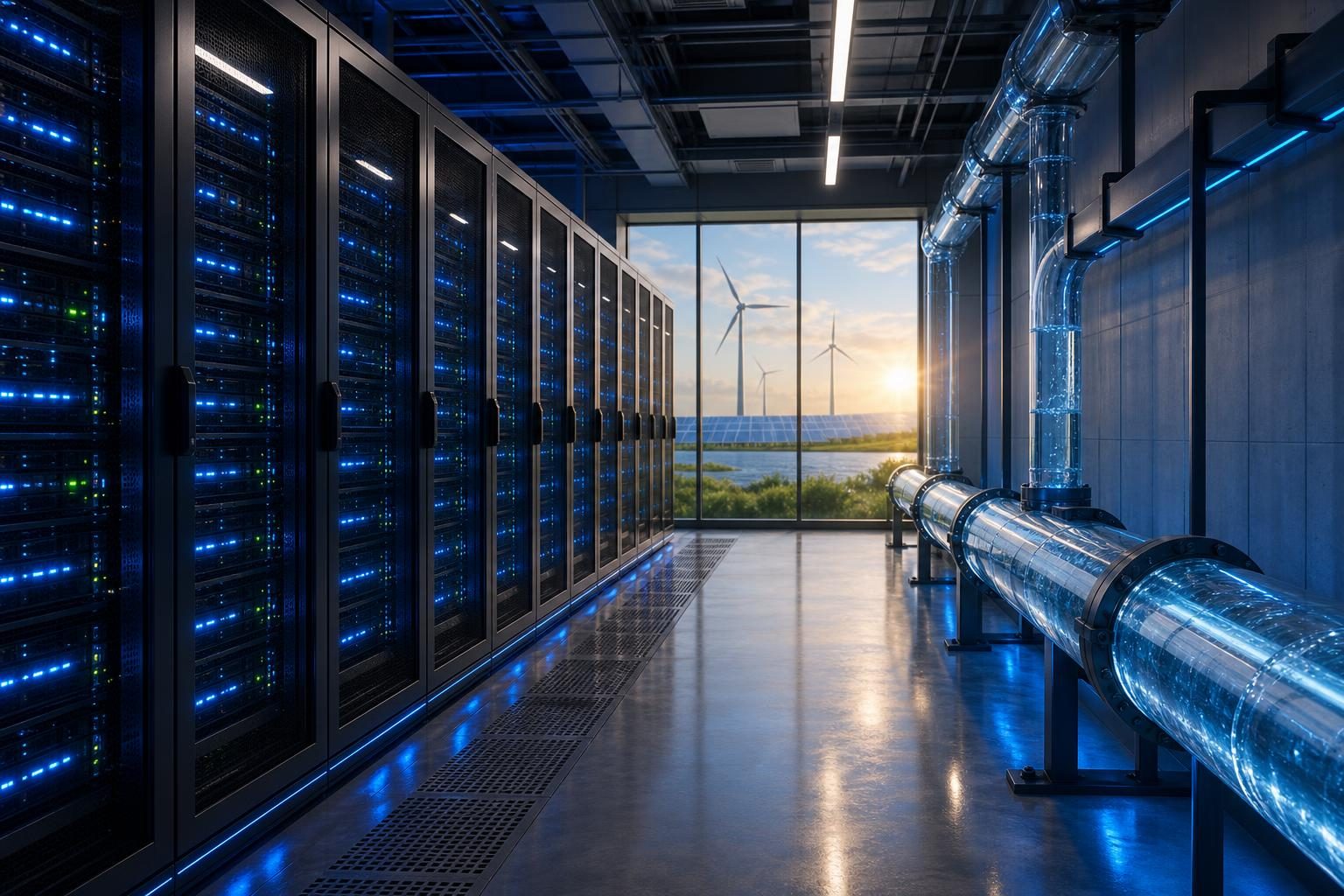
Artificial intelligence is not just something that appears on a screen. It also depends on huge buildings called data centers, which are filled with computers that store and process information. According to reporting by Live Science, some people in the United States are protesting new data centers because they can use large amounts of electricity and water, especially in places where water is already hard to spare.
AI, or artificial intelligence, is software that can do tasks that seem to need human thinking, such as answering questions or writing a paragraph. To run it, powerful computer processors do many calculations very fast. Those processors can get extremely hot, for the same reason a laptop heats up when it works hard. Some data centers use water to cool the equipment. The water absorbs heat and then cools things as it evaporates, which means it turns from liquid into vapor.
The question is not as simple as saying every AI question wastes a set amount of water. Live Science reports that claims online have ranged from a half-liter of water for one chatbot question to claims that there is no water problem at all. Experts say the truth is more complicated. In 2023, researchers estimated that data center cooling systems used 66 billion liters of water. That was less than 1 percent of total U.S. water use. Agriculture and some kinds of manufacturing use much more.
Still, small amounts can add up when millions of people use AI. One research group predicted that by 2030, U.S. data centers could use 731 billion to 1,125 billion liters of water each year when cooling and electricity are both counted. The higher number is about the same as New York City’s yearly drinking water supply, according to the article. That does not mean AI would drink New York’s water. It shows the size of the issue.
A key point is where the water is used. A data center in a wet area may not create the same problem as one in a dry area. A drought is a long period with much less rain than usual, and drought-prone places such as Arizona, New Mexico, and Southern California already face water stress. Live Science reports that researchers suggest building more data centers in places with more water and more renewable energy, such as solar or wind power. Renewable energy comes from sources that are naturally replaced, like sunlight and wind.
Energy choices matter because some water use happens before the electricity reaches the data center. Power plants that burn coal or gas often use water to cool steam after it spins turbines, which are machines that turn to help make electricity. Solar and wind power need little or no water to operate. One expert told Live Science that better site choices and other changes could reduce AI’s future water footprint by up to 86 percent. A water footprint means the total amount of water used to make or run something.
Engineers are also changing how data centers cool their machines. Older centers often used fans, chilled water, and cooling towers that lose water into the air. Many newer AI centers use liquid cooling, which moves heat away from processors more directly. AI systems have also become more efficient, meaning they can do more work with fewer resources than before. The challenge is to make those improvements faster than AI use grows.
Written from reporting by Live Science, “AI's water use is a problem, but shifting from electricity to solar or wind power could help”.
Discussion questions
- Should communities in dry areas be able to say no to new data centers, even if the centers bring jobs or better internet services? Defend your answer.
- If AI tools help people learn, work, and solve problems, how should society decide whether their water and energy costs are worth it?
- Which solution seems most important: making AI more efficient, using solar and wind power, or building data centers in wetter places? Explain your ranking.