
Free activities › Middle school
A Medieval Bread Tool May Have Been a Game Board
A wooden baking paddle found in Russia shows how ordinary objects can reveal work, play, and problem-solving from long ago.
Print it — all four files
The student packet has no answers in it. The teacher copy is the same pages plus a note on each question and the answer keys. Both languages carry the same story, the same picture and the same vocabulary.
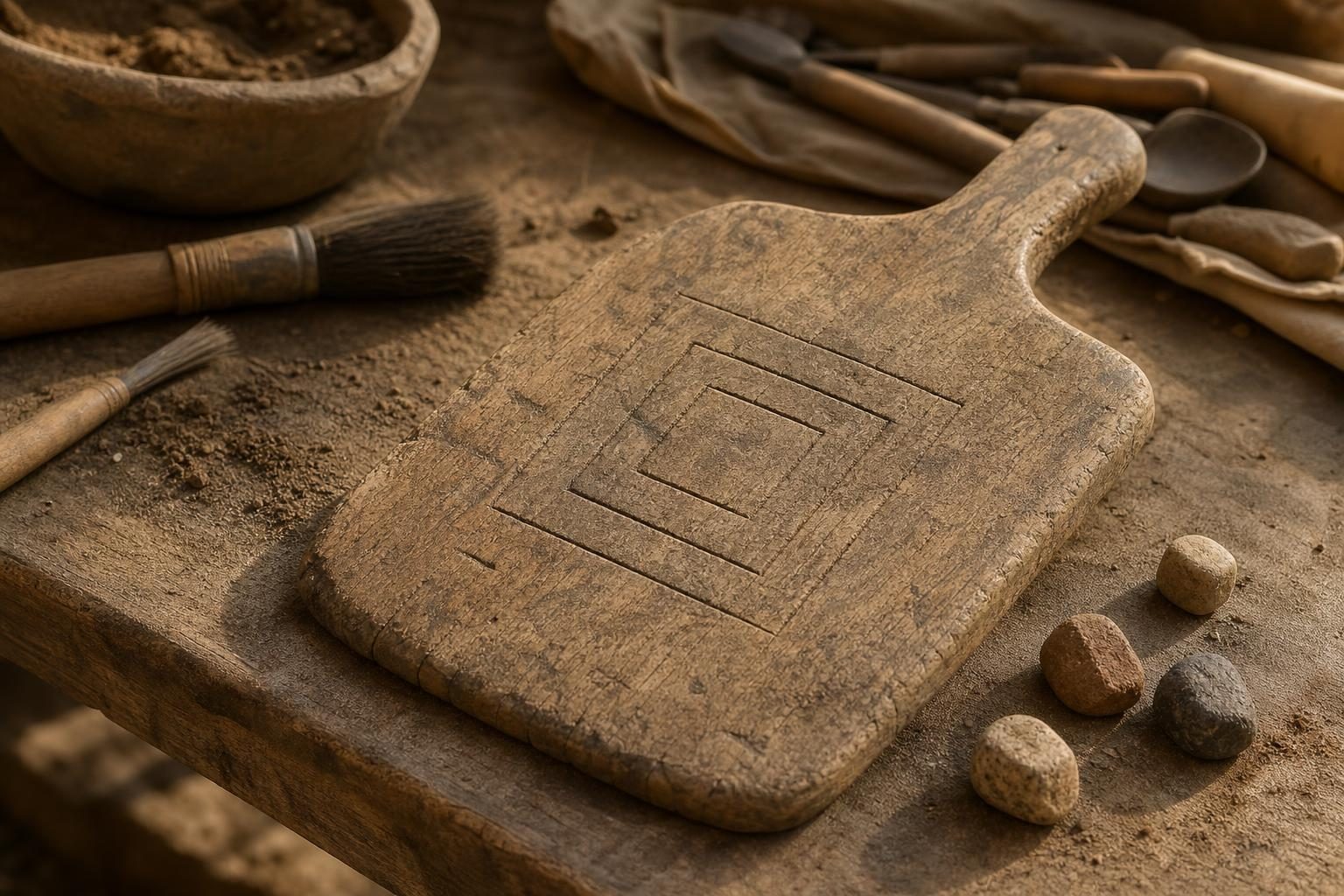
Archaeologists have found a wooden kitchen tool from the 11th century that may also have been used as a game board, according to reporting by Live Science. Archaeologists are scientists who study old objects and places to learn how people lived. The object was found at the Pyatnitsky archaeological site in Staraya Russa, a medieval town in what is now Russia. Medieval means from the Middle Ages, a period in European history between ancient times and the modern world.
The object is a fragment of a bread peel, also called a bread shovel. It is a wide wooden paddle used to move bread into and out of an oven. People today might recognize a similar tool from pizza ovens. The preserved part is about 12 by 16 inches, and researchers think it was probably made from oak. One side is flat, which would make sense for baking. The other side has three squares carved into it, one inside another.
Those carved squares look like a board for a game known by several names, including merels, mills, nine-men’s morris, and cowboy checkers. It is a two-person logic game, which means players have to plan moves and block each other. A usual merels board has three squares connected by lines. Each player has nine pieces. The goal is to line up three pieces along a line. When that happens, the player can remove one of the opponent’s pieces. Live Science describes it as a mix of tic-tac-toe and checkers.
Researchers do not know whether the bread peel was made for two jobs from the beginning or whether it was reused after it broke. That uncertainty is part of the story. In archaeology, a find often gives clues, not a complete answer. A carved board on the back of a kitchen tool could mean bakers played while waiting for bread to cook. It could also mean someone later saw a broken flat surface and turned it into a game board.
Finds like this matter because history is not only about kings, wars, or famous inventions. It is also about ordinary people using what they had. The game did not require expensive materials. A board could be scratched onto a flat surface, and small stones could serve as playing pieces. That makes the object a clue about daily life, patience, creativity, and free time in a place where most people did not leave written records.
The game itself also connects different parts of the past. Similar two-player strategy games may have been played by ancient Romans about 2,000 years ago. In the Middle Ages, merels became popular across Europe and Asia, according to the researchers cited by Live Science. That suggests games could travel across regions, just as foods, tools, languages, and stories did.
For a middle school classroom, the discovery is a reminder that evidence can be small and still important. A broken kitchen tool can raise questions about technology, trade, leisure, and culture. It also shows how historians and scientists think. They compare the object with other finds, consider more than one explanation, and avoid claiming more than the evidence can prove. The mystery is not a weakness. It is what makes the object useful.
Written from reporting by Live Science, “11th-century 'pizza peel' discovered in Russia doubled as a medieval game board”.
Discussion questions
- When archaeologists are not sure whether an object had one use or several, how should they explain their ideas to the public?
- What can games tell historians about a society that tools, weapons, or buildings might not show as clearly?
- If a common object from today were found 1,000 years from now, what might future archaeologists misunderstand about it?