
Free activities › Middle school
Old Bones, New Clues at Westminster Abbey
A reused Roman stone coffin may reveal the identity of a medieval church leader after 150 years of questions.
Print it — all four files
The student packet has no answers in it. The teacher copy is the same pages plus a note on each question and the answer keys. Both languages carry the same story, the same picture and the same vocabulary.
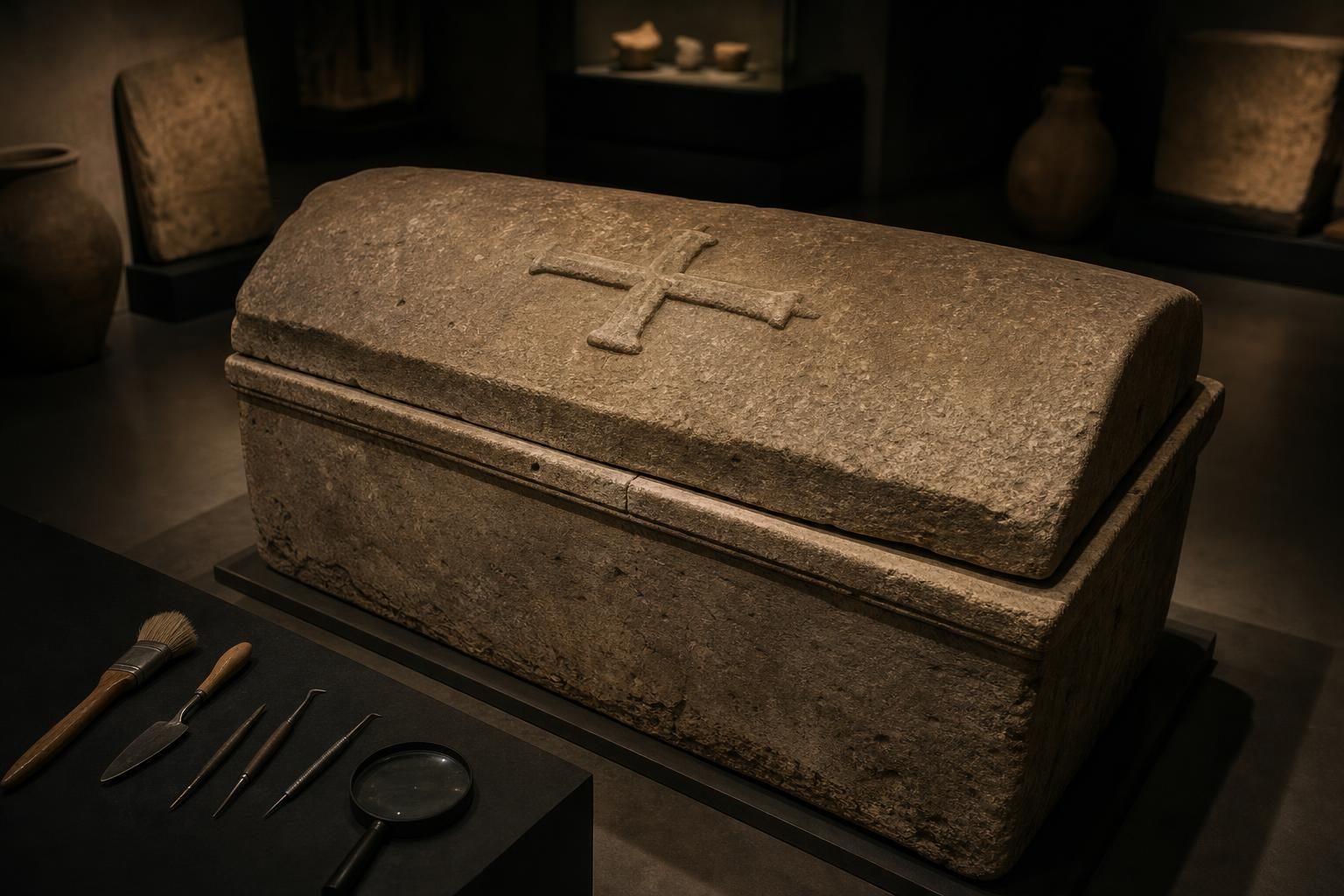
An old mystery at Westminster Abbey in London may finally have a strong answer. According to reporting by Live Science, Westminster Abbey’s consulting archaeologist says a skeleton found inside a reused Roman-era sarcophagus was probably a medieval abbot. A sarcophagus is a stone coffin, and an abbot is the leader of a monastery, a religious community where monks live and work.
The coffin was first uncovered in 1869 by Westminster’s chief mason. Westminster Abbey is a famous church where many important people in British history are buried or honored. The strange part was that the coffin seemed to belong to two different times. Its base had a fourth-century Roman funeral inscription in Latin, the language used by ancient Rome. But the lid had a large 11th-century Anglo-Saxon cross carved into it. Anglo-Saxon refers to people and culture in England before the Norman Conquest of 1066.
For nearly 150 years, experts knew the tomb had been looted, meaning someone had stolen things from it, and they thought no bones were left. Then, in 2016, the coffin was opened for conservation, which means careful work to protect and study an old object. Inside was a full skeleton, though the bones had been disturbed. Some arm and leg bones were mixed up, and the skull had been damaged in the past.
The bones gave researchers new clues. A bioarchaeologist, a scientist who studies human remains from the past, reported that the person was male, middle-aged, and of average height. The bones showed signs of osteoarthritis, a joint disease that can cause pain and stiffness, as well as two healed rib injuries and gout, a painful joint condition. Scientists also carbon-dated the bones. Carbon dating is a method that estimates age by measuring a form of carbon left in once-living things. The test placed the bones between 987 and 1052.
That date range matters because it fits the time when Westminster had abbots who could have been buried there. The archaeologist, Warwick Rodwell, compared the dates with known abbots of Westminster and narrowed the possible identities to three men: Wulfsige, Ælfwig, and Wulfnoth. Wulfsige later became a bishop somewhere else, so he was probably not buried at Westminster. That leaves Ælfwig and Wulfnoth as stronger possibilities. Rodwell suggested Ælfwig may be the better fit because he had already been a monk at Westminster.
The case is not completely closed. There were no grave goods, which are objects buried with a person, because they may have been stolen long ago. Experts also do not know why an important medieval church leader would be buried in a coffin first made for a Roman man named Valerius Amandinus. The Roman inscription says it was made in memory of him by two people described as his sons. Rodwell noted that reusing a Roman coffin this way is extremely unusual.
That uncertainty is part of why the story matters. In social studies, a single artifact can be like a primary source, a piece of evidence from the time being studied. In science, evidence has to be tested, compared, and sometimes questioned. This one coffin brings together art, language, religion, chemistry, and human bones. It shows that history is not only a list of dates. Sometimes it is a puzzle, and the best answer is the one that fits the most evidence while admitting what is still unknown.
Written from reporting by Live Science, “Case of mysterious medieval skeleton buried in Roman-era sarcophagus at Westminster Abbey finally solved”.
Discussion questions
- When evidence points to a likely answer but not a certain one, how should museums or historians explain that to the public?
- Which kind of evidence in this case seems most important: the carved symbols, the written inscription, the carbon dating, or the location of the burial? Defend your choice.
- What are the benefits and risks of opening and studying old burials, even when the goal is to learn history?