
Free activities › Middle school
England Plans Healthier Rules for School Lunches
New school meal rules would limit fried foods and sweets while requiring more fruits, vegetables, and whole grains.
Print it — all four files
The student packet has no answers in it. The teacher copy is the same pages plus a note on each question and the answer keys. Both languages carry the same story, the same picture and the same vocabulary.
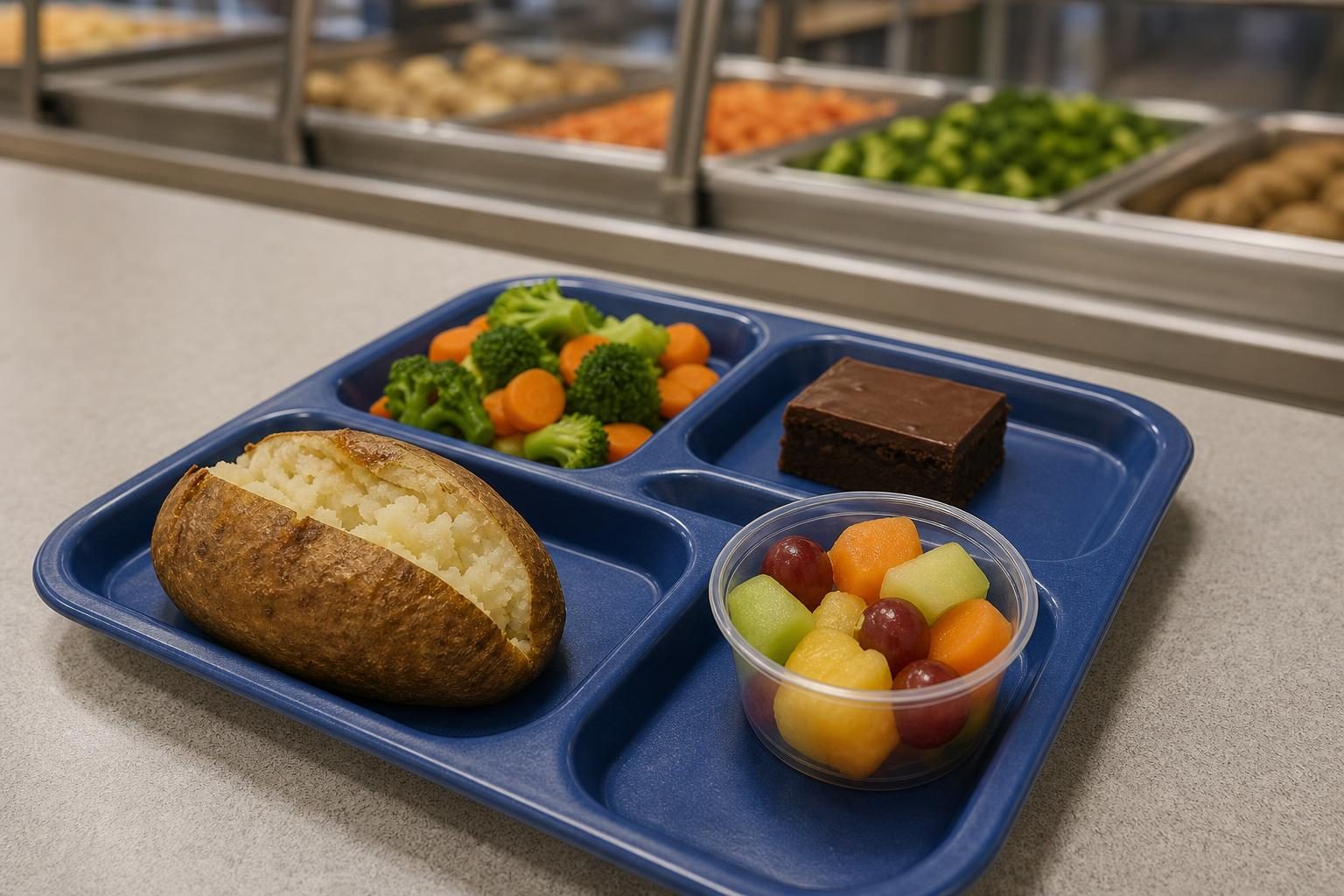
England is changing the rules for food served in primary and secondary schools. According to BBC Newsround, the new rules will require schools to offer more fruits and vegetables, stop serving deep-fried foods, and limit some sweet foods and processed meats. The changes are planned to begin in 2027, with secondary schools getting until September 2028 for some parts of the plan.
The rules will affect school dinners, which are lunches served at school, and breakfast clubs, which are before-school programs where children can eat. Deep-fried foods will be banned, so foods such as chips, meaning the British word for thick fries, would need to be baked in an oven instead. Foods such as sausages, ham, and chicken nuggets would be limited to once a week, and they would have to be served with fruit or vegetables.
Schools will also need to serve more high-fiber foods, such as whole-grain bread. Fiber is the part of plant foods that the body does not fully digest, and it helps digestion work well. Cake and other sweet desserts will be limited to twice a week in secondary schools and once a week in primary schools. When sweets are served, they will need to come with fruit.
Breakfast clubs would change, too. From next September, pastries and fried eggs will no longer be allowed, and cereals will have limits on how much sugar they contain. Schools will have to publish their menus and food policies online, which means families can see what is being served. Schools will also be monitored, meaning checked, to make sure they follow the rules.
The goal is to make school food healthier. The government says better nutrition can help children’s concentration, learning, and well-being. Nutrition means the way food gives the body energy and materials to grow, move, and think. This connects to science classes because food is not only about taste. It is also about how bodies use carbohydrates, proteins, fats, vitamins, minerals, and water.
The story also connects to civics, the study of how governments and communities make decisions. A school lunch rule may sound small, but it shows how a government can affect daily life. The rule is not just advice. Schools will be expected to follow it. That raises a real question: when should adults in charge make rules about what children eat, and when should families and young people decide for themselves?
Money is one of the biggest questions. BBC Newsround reports that no new money has been set aside for the changes. Some school leaders say schools need more support to make the plan work. Healthier food can cost more, take more time to prepare, or require different kitchen equipment. A rule that sounds simple on paper can be harder in a busy cafeteria with a budget, staff schedules, and hundreds of meals to serve.
There is also disagreement about priorities. Some critics, including the Conservative Party, say the government should focus on other issues instead of changing school menus. That does not mean the food rules are unimportant. It means people disagree about what problem should come first and how much government should do.
These rules apply to England. Other parts of the United Kingdom have their own school food rules. Wales, Scotland, and Northern Ireland already have guidance or rules about fruits, vegetables, bread, drinks, and other foods. The details are different, but the larger issue is the same: schools do more than teach math and reading. They also make choices that affect health, fairness, cost, and daily routines.
Written from reporting by BBC Newsround, “Changes coming to school dinners - what do you think of yours?”.
Discussion questions
- Should schools have the power to limit certain foods if the goal is better health, or should food choices mostly belong to families? Defend your position.
- If a government creates a school food rule but does not provide new money, is that fair to schools? Why or why not?
- What information would you want before judging whether these rules will actually help students learn and feel better?