
Free activities › Middle school
Football Brain Study Shows Risk—and Uncertainty
A new study on former NFL players raises health questions and shows why samples matter in science.
Print it — all four files
The student packet has no answers in it. The teacher copy is the same pages plus a note on each question and the answer keys. Both languages carry the same story, the same picture and the same vocabulary.
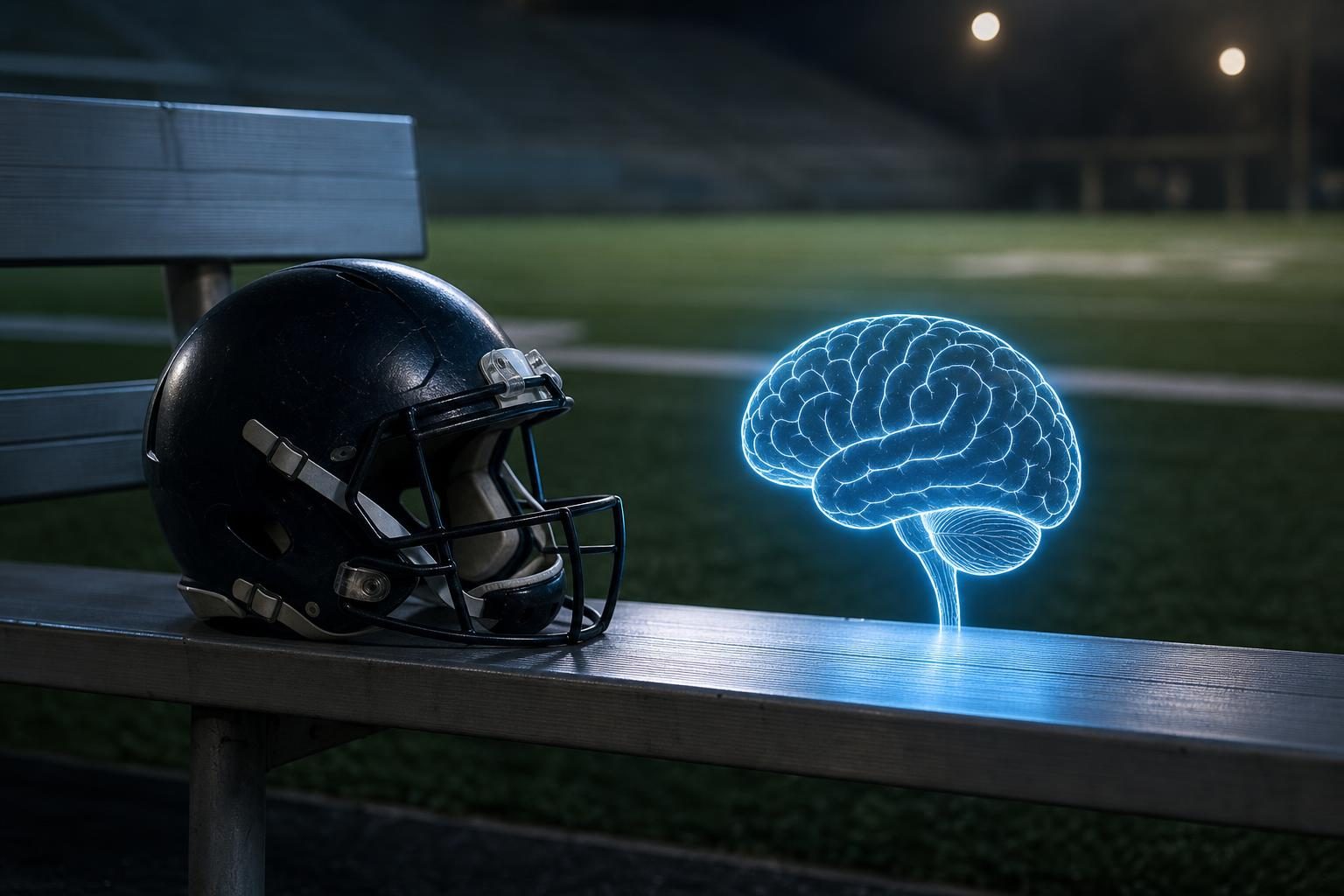
According to Live Science, a new study published in the journal The BMJ looked at the brains of former National Football League players and found signs linked to CTE in many of them. The NFL is the top professional football league in the United States. CTE, short for chronic traumatic encephalopathy, is a brain disease linked to repeated hits to the head. It can only be confirmed by studying brain tissue after death. The study estimated that at least one-quarter of former NFL players who died in recent years had brain changes related to CTE.
Researchers examined donated brain tissue, meaning brain samples given to science after death, from 338 former NFL players who died between 2008 and 2021. In that same time, 1,712 former players died, so the study included about one-fifth of the possible cases. Among the donated brains, more than 93% showed physical signs of CTE. About 30% had stage IV CTE, the most severe stage. These signs involved abnormal proteins, which are tiny parts of cells, building up in specific places in the brain tissue.
The numbers sound simple at first, but the study’s biggest lesson may be about uncertainty. The researchers used the donated brains to estimate prevalence, which means how common something is in a group. Their estimate for all former NFL players who died during the study period ranged from 18.5% to 98.7%. For 2016 to 2021, the years with the most brain donations, the estimate ranged from 24.5% to 97.7%. A range that wide means scientists cannot point to one exact number with confidence.
One reason is selection bias, a study problem that happens when the people included may not match the larger group. Families may have been more likely to donate a brain if a player had memory, mood, or behavior problems before death. That would make CTE look more common in the donated group than in all former players. On the other hand, not every player with CTE symptoms would have had a donated brain. The study tried to handle that problem by comparing the donated brains with the larger list of former players who died.
The study also separated brain changes from symptoms. Symptoms are problems a person feels or shows. About 60% of the people with CTE-related brain changes had also been diagnosed with dementia, a condition that causes serious trouble with memory and thinking. Among those with stage IV CTE, 90% had dementia. That connection matters, but it does not mean every person with CTE changes had the same life or the same symptoms.
Live Science asked Thayne Munce, a University of Kansas concussion researcher who was not part of the study, what the findings mean. A concussion is a brain injury caused by a hit or jolt that can affect how someone thinks, feels, or moves. Munce said the study should not be applied directly to all football players, including young athletes or even today’s NFL players. Extrapolate means to use information from one group to make claims about another group, and he warned against doing that too quickly.
For someone in middle school, the story is not just about football. It is about how people use evidence to make choices when the evidence is serious but incomplete. In science class, data sets, samples, and limits on conclusions are part of the work. In health or physical education, brain safety is part of understanding sports. The hard question is not whether one study settles everything. It is how leagues, families, doctors, and players should respond while scientists keep studying the risk.
Written from reporting by Live Science, “'This is probably the safest time to be playing the sport of football': Concussion expert explains why viral CTE study may not be as scary as it sounds”.
Discussion questions
- When evidence about a sport is serious but uncertain, should leagues change rules right away or wait for stronger proof? Defend your view.
- How should the donated-brain sample affect the way news headlines describe this study?
- Should research on former professional athletes be used to guide decisions in youth sports? Why or why not?