
Free activities › Middle school
French School Protests Close Hundreds of Campuses
Teenagers are demanding better school conditions, while officials warn that some protests have become unsafe.
Print it — all four files
The student packet has no answers in it. The teacher copy is the same pages plus a note on each question and the answer keys. Both languages carry the same story, the same picture and the same vocabulary.
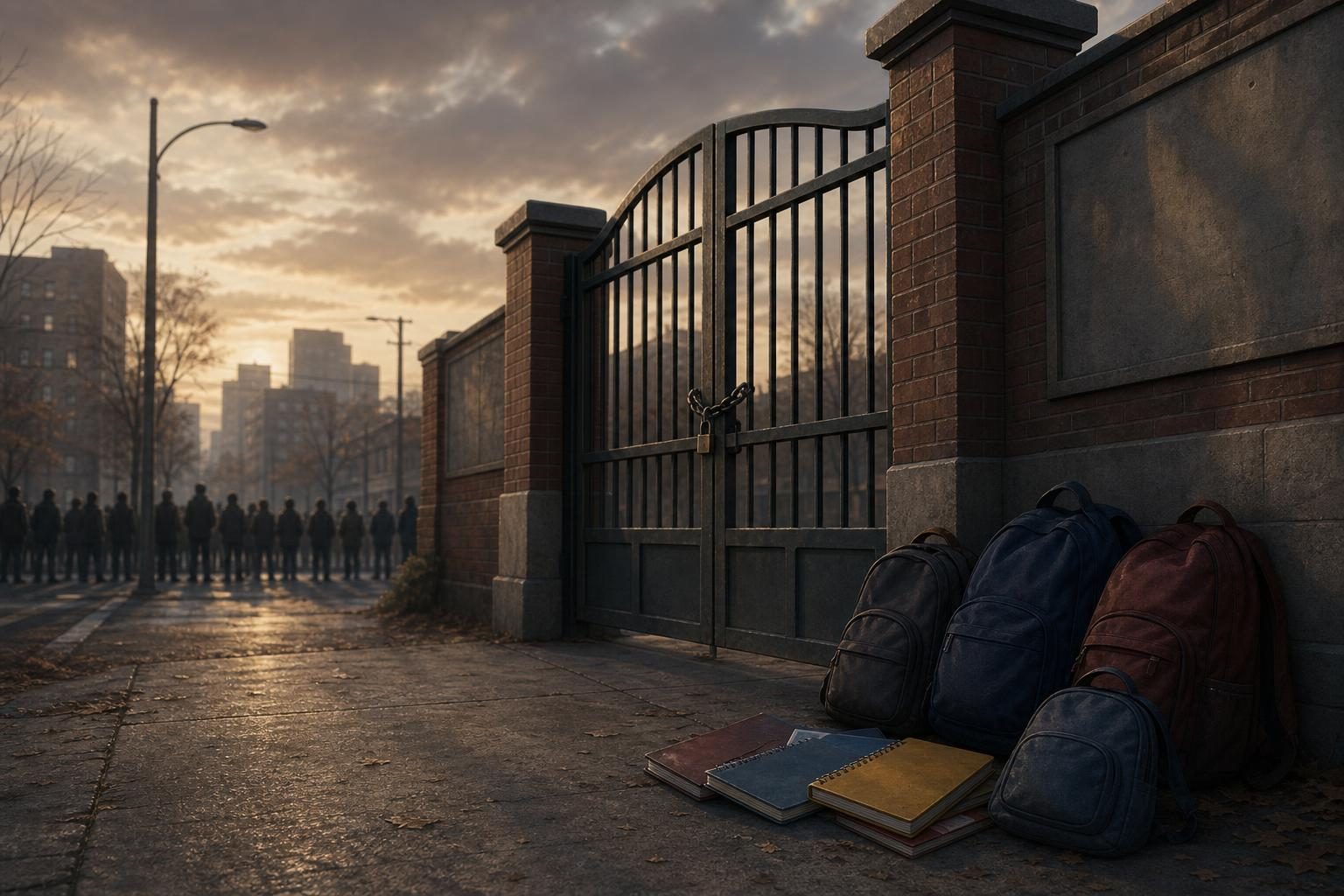
About 500 schools in France were expected to be partly or fully closed on Monday as protests by high-school-age students continued, according to BBC Newsround. The students say they are upset about poor school buildings, crowded classes, old equipment, and a shortage of teachers. The protests began in and around Paris, France’s capital, last week and have spread to cities including Dijon, Lyon, Strasbourg, Lille, and Marseille.
This matters because the argument is about something every middle schooler understands: what a school needs in order for learning to happen. A classroom can have a teacher, a schedule, and assignments, but learning gets harder when there are too many people in the room, not enough adults, or equipment that does not work well. The French students are saying those conditions are not just annoying. They are unfair.
The protests have disrupted normal school life. France’s education minister, Édouard Geffray, said around 500 schools could be affected Monday and promised a “partial, progressive return to lessons.” Partial means not complete, and progressive means happening step by step. On Friday, French Justice Minister Gérald Darmanin said 735 of France’s 3,700 schools had been affected in some way.
Some students are using a tactic called a blockade, which means blocking the entrance to a place so people cannot easily get in. A student union called USL asked students at French lycées to block school gates. A union is a group that organizes people to speak up for shared interests, and lycées are schools for older teenagers, similar to the last years of high school.
The protests also raise a hard question: how far should a protest go? BBC Newsround reported clashes between police and demonstrators, as well as reports of vandalism and protesters throwing fireworks and other objects at police in several cities. Thousands of people, most of them under 18, have been arrested. Officials say they are worried about violence. Prime Minister Sébastien Lecornu warned that any further escalation, or worsening of the conflict, would be irresponsible.
At the same time, some demonstrators say police are treating them unfairly. In Seine-Saint-Denis, an area north of Paris, protesters said police used unreasonable tactics, including tear gas. Tear gas is a chemical spray that can make people’s eyes burn and can make breathing difficult. Education Minister Geffray said some student demands were legitimate, meaning they had a fair reason behind them, but he was worried about the violence.
The story connects to civics, which is the study of how people take part in public life, because it shows both the power and the risk of public protest. A protest can draw attention to a problem that leaders might otherwise ignore. It can also interrupt other people’s day, close schools, and create situations where people get hurt or arrested. The same action can look brave to one person and unsafe to another.
It also connects to social studies questions about equality. Some students near Paris told the BBC they believe their schools get less money than richer schools in central Paris. The source did not give figures to prove or disprove that claim, so it should be treated as what protesters are arguing, not as a settled fact. Still, the claim is important because unequal school resources can shape what choices young people have later.
The protests are expected to continue, with USL calling for a large national day of protest on Tuesday, Oct. 6. The outcome is not clear. What is clear is that the debate is about more than one country. It is about what makes a school fair, safe, and able to do its job.
Written from reporting by BBC Newsround, “Hundreds of schools closed in France as student protests continue”.
Discussion questions
- When students believe their schools are unfairly under-resourced, what kinds of protest actions are justified, and where should the line be drawn?
- If leaders had to decide whether the protesters’ complaints were fair, what evidence should they look for before making changes?
- Do blockades make a protest more powerful or less persuasive? Defend your view using this situation or another example.