
Free activities › Middle school
French Teens Push School Funding Into the Streets
A protest movement that began at one high school has grown into a national argument over education, safety, and public voice.
Print it — all four files
The student packet has no answers in it. The teacher copy is the same pages plus a note on each question and the answer keys. Both languages carry the same story, the same picture and the same vocabulary.
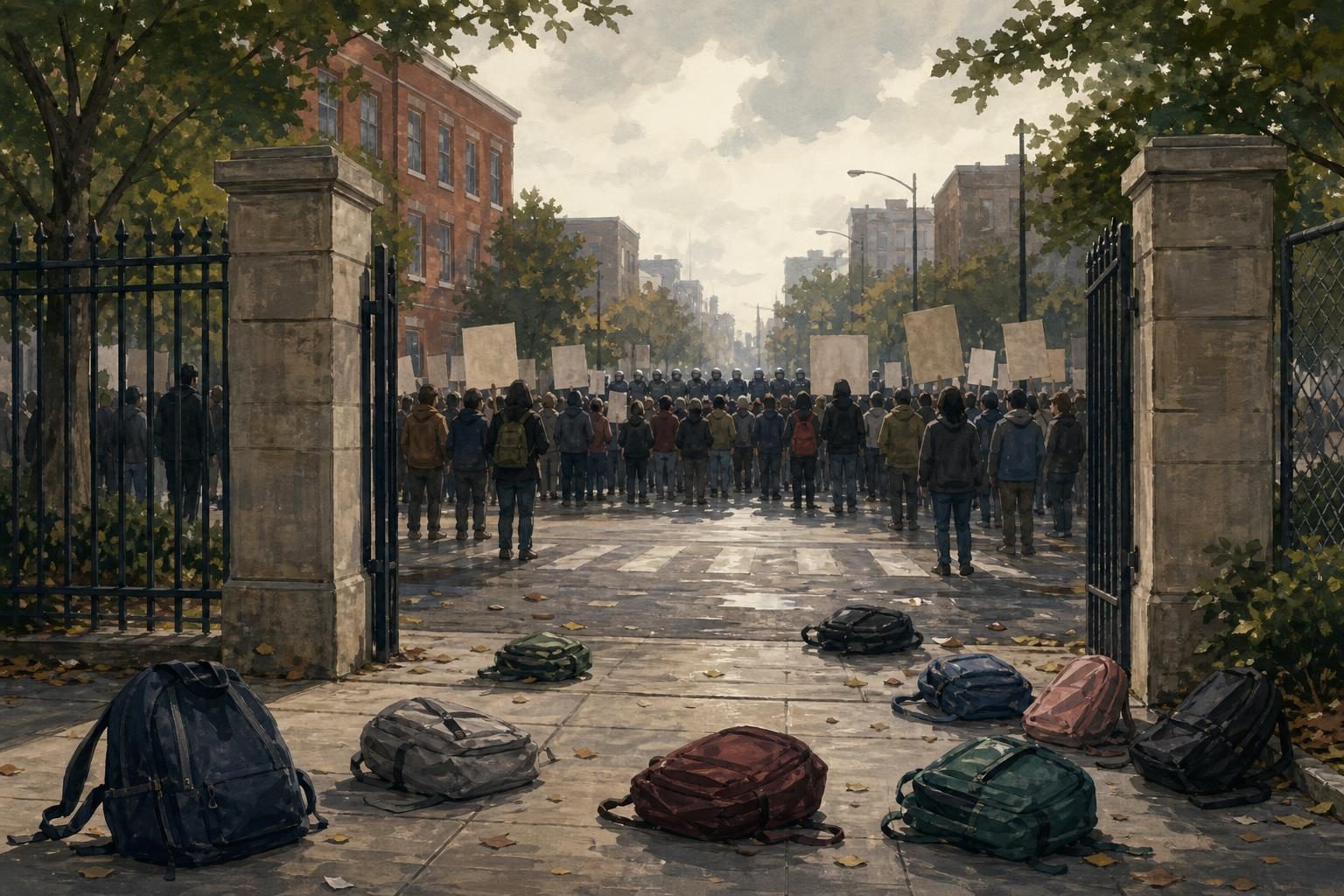
More than a quarter-million people marched across France on Tuesday in a student-led protest movement demanding more money for schools, according to reporting by PBS NewsHour. The movement began at one high school in mid-September and has grown into marches, strikes, and blockades, which are barriers set up to stop normal activity. In Paris, authorities said 56,000 students, parents, and teachers marched. Similar protests took place in cities including Strasbourg and Lyon.
The protests are about the condition of schools. Marchers are demanding more education funding because they say schools are understaffed, classrooms are overcrowded, and academic buildings are in poor shape. Those complaints are not just adult issues. They affect how much help a young person gets from a teacher, how noisy or crowded a class feels, and whether a school building is safe and ready for learning.
The day also showed a hard question in civics: What happens when a peaceful demand meets public disorder? In some cities, police and protesters clashed. Police in riot gear, which is protective equipment used during unrest, fired tear gas, a chemical that stings the eyes and makes breathing difficult. French officials said some people tried to confront officers. Prime Minister Sebastien Lecornu condemned what he called “extreme violence.”
The numbers show how large and tense the movement has become. Since the protests began in mid-September, roughly 6,000 people have been arrested, according to the PBS report. About 300 students and staff have been injured, along with about 700 police officers. France’s interior minister said the police response has been proportionate in almost all cases, meaning he argued officers used no more force than the situation required. Protesters and some parents, however, said the police response has made anger grow.
Union activists also joined the marches. A union is a group of workers that organizes to speak together about pay, working conditions, or public policy. Their involvement matters because it shows the protest is no longer only a school hallway issue. It has become a national debate over how a country chooses to spend public money and how much power young people can have when they organize around a problem they experience every day.
This story connects to subjects that show up in many classrooms. In social studies, it raises questions about rights, public order, and democracy. Demonstrating means protesting in public to show support for a cause, and many democratic countries protect that right. But governments also have a duty to keep streets and schools safe. In math or economics, the issue is about budgets: if a government spends more on schools, that money has to come from taxes, cuts somewhere else, or new borrowing. In language arts, the story is about persuasion: students, parents, police, officials, and reporters are all trying to shape how the public understands the same events.
The protests do not have a simple lesson. A large crowd does not automatically prove a demand is right. A government’s warning about disorder does not automatically prove protesters are wrong. The central question is how a society listens to young people when they say a public system is failing them, especially when the argument moves from classrooms to city streets.
Written from reporting by PBS NewsHour, “French students lead massive protests against education policies”.
Discussion questions
- When young people protest about their schools, what responsibilities should protest organizers and government officials each have to keep people safe without silencing the message?
- Should the size of a protest make leaders more likely to change policy, or should leaders rely mostly on budgets, data, and expert advice? Defend your view.
- What information is missing from this story that would help you judge whether the protesters’ demands are fair and realistic?