
Free activities › Middle school
NASA Plans a Stronger Message Link for Mars
A new spacecraft around Mars could move more science data and help guide future missions.
Print it — all four files
The student packet has no answers in it. The teacher copy is the same pages plus a note on each question and the answer keys. Both languages carry the same story, the same picture and the same vocabulary.
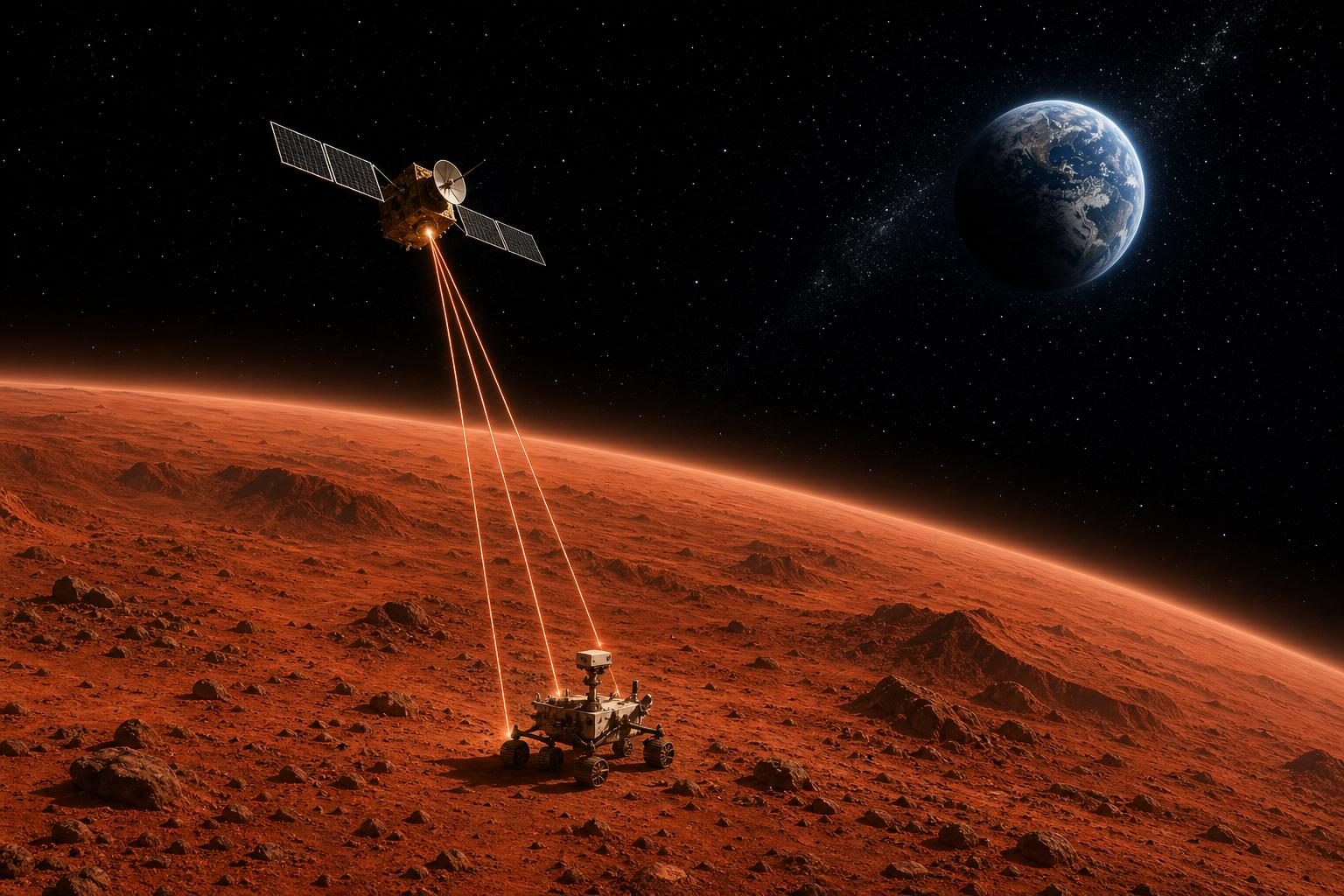
NASA has chosen Blue Origin to build and run a new communications system for Mars, according to NASA. The contract could be worth about $700 million. Blue Origin must deliver a high-performance spacecraft to NASA no later than Dec. 31, 2028.
The spacecraft will orbit Mars. An orbiter is a spacecraft that travels around a planet or moon instead of landing on it. This one will act like a relay station. It will pass along science data, pictures, navigation information, and important mission messages from spacecraft on or near Mars.
NASA calls the project the Mars Telecommunications Network. Telecommunications means sending information over long distances. On Earth, that can mean phone calls, video chats, and internet signals. Around Mars, it means helping robots and other spacecraft send their findings back across space.
The new system is meant to have high bandwidth. Bandwidth is the amount of information a system can carry at one time. Higher bandwidth can mean more data moves faster. For a Mars mission, that could matter if a spacecraft is sending detailed images, measurements from science tools, or directions needed to move safely.
This matters because exploring Mars is not only about rockets and robots. It is also about communication. A rover can collect important information, but that information has to reach scientists. A future mission may also need clear signals to know where it is and what to do next. Without strong communication, even a successful spacecraft could be limited in what it can share.
NASA says the network will support both current and future Mars missions. The agency expects it to be working at Mars by 2030. That timing matters because NASA says demand for data will grow as more missions study the Red Planet, which is a common nickname for Mars because of its rusty color.
The project also connects to NASA’s larger plan for space exploration. Under the Artemis program, NASA is sending astronauts to the Moon and using that work to prepare for future Mars missions. Robotic missions, meaning missions done by machines instead of people, are expected to help prepare the way for human exploration.
The contract shows another change in how space work is done. NASA says it is increasingly using commercial partners. A commercial partner is a private company that works with the government on a project. In this case, Blue Origin will design, develop, put together, launch, and operate the Mars network.
NASA says this lets the agency use private-sector skills while it focuses on exploration and science. That choice also raises useful questions. When a government agency hires a company, it can gain speed, tools, and experience. It also has to make sure the public gets value from the money spent.
For a middle school science class, the story connects to several ideas that already come up in class. Signals travel across distance. Machines need energy, instructions, and feedback. Scientists depend on data, which means information gathered through observation or measurement. Space exploration is not just one dramatic launch. It is a whole system of planning, engineering, communication, and problem solving.
The Mars Telecommunications Network is not a rover and not a human mission. It may not look as exciting as a rocket leaving Earth. But it could become part of the background system that makes future discoveries possible. Before people can explore farther from Earth, they need a reliable way to listen, send, guide, and learn.
Written from reporting by NASA, “NASA Selects Blue Origin as Mars Telecommunications Network Provider”.
Discussion questions
- NASA is paying a private company to build and operate this Mars communication system. What are the strongest reasons for doing that, and what concerns should the public still have?
- The new orbiter is not designed to land on Mars or collect samples itself. Make an argument for why a communication system can still be as important as a rover or lander.
- If future Mars missions can send back much more data, how might that change what scientists can ask and learn?