
Free activities › Middle school
NASA Shows How Famous Movie Rocks Got Their Tilt
Vasquez Rocks look like an alien planet, but their shape tells a real story about water, rock, and moving plates.
Print it — all four files
The student packet has no answers in it. The teacher copy is the same pages plus a note on each question and the answer keys. Both languages carry the same story, the same picture and the same vocabulary.
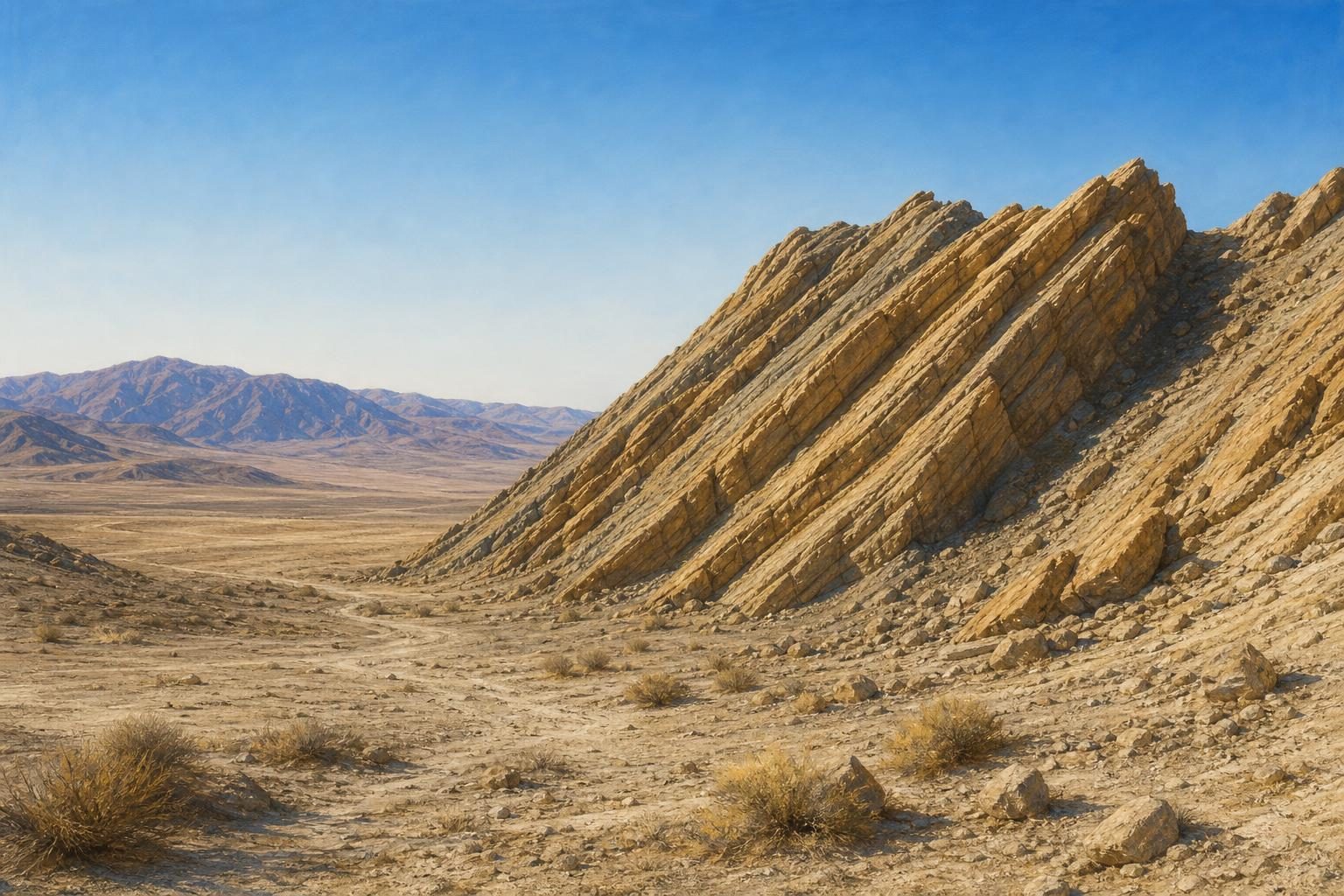
NASA’s Earth Observatory highlighted Vasquez Rocks in Southern California this week, according to NASA, showing how a famous filming location also tells a deep Earth science story. The jagged rocks have appeared in Star Trek and other science fiction shows because they look strange and otherworldly. But their real story is not about aliens. It is about sediment, pressure, moving plates, and millions of years of change.
Vasquez Rocks Natural Area sits in the Soledad Basin, a basin being a low area of land surrounded by higher land. The rocks stand out because many of their layers lean at sharp angles instead of lying flat. Geologists, scientists who study Earth’s materials and history, estimate that the sedimentary rock strata there tilt about 50 degrees on average. Sedimentary rock forms from pieces of older rock, sand, mud, or other material that build up in layers. Strata are those layers. At Vasquez Rocks, the tilted layers are so steep that some ridges seem to point upward toward the sky.
Those rocks did not begin that way. NASA explains that about 25 million years ago, sediment spread out across alluvial fans. An alluvial fan is a cone-shaped pile of sediment that forms when a fast stream flows out onto flatter land and drops what it is carrying. Much of the material probably came from nearby higher land. Over time, the layers were buried and cemented together into sandstone and conglomerate. Sandstone is rock made mostly from sand-sized grains. Conglomerate is rock made from rounded pieces of older rock held together.
The next part of the story involves tectonic plates, the huge moving pieces of Earth’s outer shell. Near Vasquez Rocks, two plates move past each other along a boundary that includes the San Andreas Fault. A fault is a crack or zone of cracks in Earth’s crust where rocks move. The San Andreas is a strike-slip fault, which means the land on each side slides mostly sideways. NASA says the North American plate moves southeast there while the Pacific plate moves northwest. Over a very long time, those forces lifted, bent, folded, and rotated the rock layers in the Soledad Basin.
After the layers were tilted, weathering and erosion kept shaping them. Weathering breaks rock down, and erosion moves broken material away by wind, water, gravity, or ice. Softer material wore away more easily. Harder sandstone and conglomerate remained as fins and ridges. That is why the landscape now has sharp stone shapes that can look like a set for another planet.
NASA also showed how the rocks appear from space. Landsat 9, an Earth-observing satellite, carried an instrument called the Operational Land Imager that captured the area. In natural color, the view looks more like what human eyes might see. In false color, scientists use light that human eyes cannot see, such as infrared light, to make differences in land and plants easier to spot. From orbit, Vasquez Rocks look less dramatic than they do from the ground, but they still appear as gray bands between mountain ranges.
This matters beyond one park. A place used to imagine faraway worlds can also help explain this one. The same landscape connects rock layers, plate motion, satellite technology, and the way movies use real places to create make-believe settings.
Written from reporting by NASA, “The Otherworldly Geology of Vasquez Rocks”.
Discussion questions
- Should a place like Vasquez Rocks be taught mainly as a science site, a cultural landmark, or both? Defend your choice.
- What can a satellite view help people understand about a landscape, and what might it leave out compared with visiting on the ground?
- If a local place near your community had a hidden science story, what kinds of evidence would you look for before explaining it to others?