
Free activities › Middle school
New Armored Dinosaur Helps Trace an Ancient Journey
A fossil from Japan suggests some armored dinosaurs may have crossed a land bridge from North America to Asia.
Print it — all four files
The student packet has no answers in it. The teacher copy is the same pages plus a note on each question and the answer keys. Both languages carry the same story, the same picture and the same vocabulary.
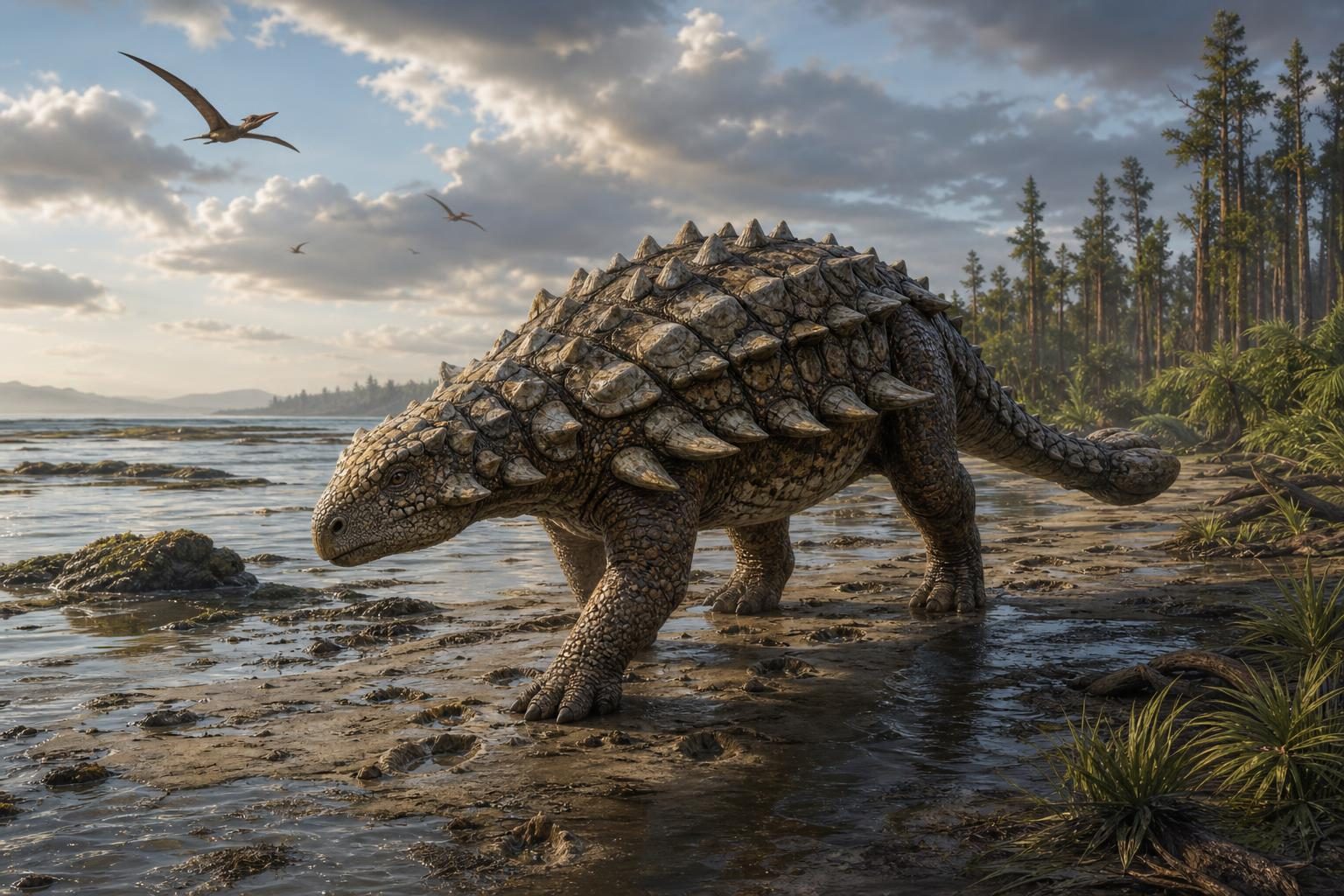
Scientists have given a name to a rare armored dinosaur first found in Japan more than 30 years ago, according to Live Science. The dinosaur, Nipponopelta yezoensis, was a nodosaurid, an armored dinosaur covered in bony plates. Its fossils were found in 1995 on Hokkaido, Japan’s northernmost main island. Researchers reexamined the remains, including the back of the skull, part of the lower jaw, teeth, and bony plates, and concluded they belonged to a species scientists had not named before. The name combines ‘Nippon,’ meaning Japan, and ‘pelta,’ a Greek word for shield; ‘Yezo’ is a traditional name for Hokkaido.
This discovery matters because it shows how new science can come from old evidence. The fossil was not newly dug up last week. The new part was the closer look. The research team used computed tomography, or CT scanning, which makes digital 3D images so scientists can study the inside of an object without cutting it open. That helped them compare the dinosaur’s bones with other armored dinosaurs. In science class, that is a reminder that better tools can change what old evidence can tell us.
Nipponopelta is also important because nodosaurids are rare in Asia. Live Science reports that it is now one of only three known Asian species of its kind. Nodosaurids were close relatives of ankylosaurids, another group of armored dinosaurs, but nodosaurids did not have the heavy tail clubs that ankylosaurids used for defense. The Japanese dinosaur’s body details look similar to nodosaurids from North America. That led the researchers to suggest that its ancestors may have reached Asia by crossing the Bering Land Bridge, an ancient strip of land that once connected what are now Alaska and Russia, about 100 million to 110 million years ago.
That idea connects fossils to geography. Today, the Bering Strait is water, and Japan is a chain of islands. In the Cretaceous Period, the time when this dinosaur lived, Earth’s lands and seas were not arranged exactly as they are now. A land bridge could let animals spread into new places without swimming across an ocean. If Nipponopelta’s ancestors moved that way, the fossil is more than a dinosaur bone. It is a clue about ancient travel routes, coastlines, and how living things spread when the planet changes.
The place where the fossil was found adds a puzzle. The rocks were marine sediments, meaning rocks that formed under ancient seas. Nodosaurids did not live in the ocean. Researchers think the animal’s body may have been carried by a river or an estuary, a place where river water meets the sea, before it sank to the ocean floor. Other nodosaurid fossils have also been found in marine deposits. That may mean these animals often lived near coasts, which could have helped them follow coastal routes as they spread. But it does not prove they lived only by the ocean.
Scientists are careful about that last point because fossils do not preserve the whole past. A paleontologist, a scientist who studies ancient life, told Live Science that uplands and mountains often leave fewer fossils because erosion wears away rock. Another researcher said scientists do not yet know whether Asia has few nodosaurids because the right rocks have not been found or because the animals did not spread into many Asian species. That uncertainty is part of the story. Nipponopelta gives scientists one more piece of evidence, but it also shows how much of dinosaur history is still missing.
Written from reporting by Live Science, “Rare armored dinosaur found in Japan may have ancestors that migrated across a land bridge 100 million years ago”.
Discussion questions
- When scientists name a new species from an incomplete fossil, what kinds of evidence should be enough, and what risks should they be careful about?
- Do you think the coastal fossil evidence is strong enough to suggest nodosaurids often lived or traveled near coasts? Why or why not?
- Should museums and scientists spend more time reexamining old fossils with new tools, or searching for new fossils in the field?