
Free activities › Middle school
Volcano Ash Grounds Flights in Indonesia
Anak Krakatau’s eruption shows how Earth science, satellites, health, and travel can meet in one event.
Print it — all four files
The student packet has no answers in it. The teacher copy is the same pages plus a note on each question and the answer keys. Both languages carry the same story, the same picture and the same vocabulary.
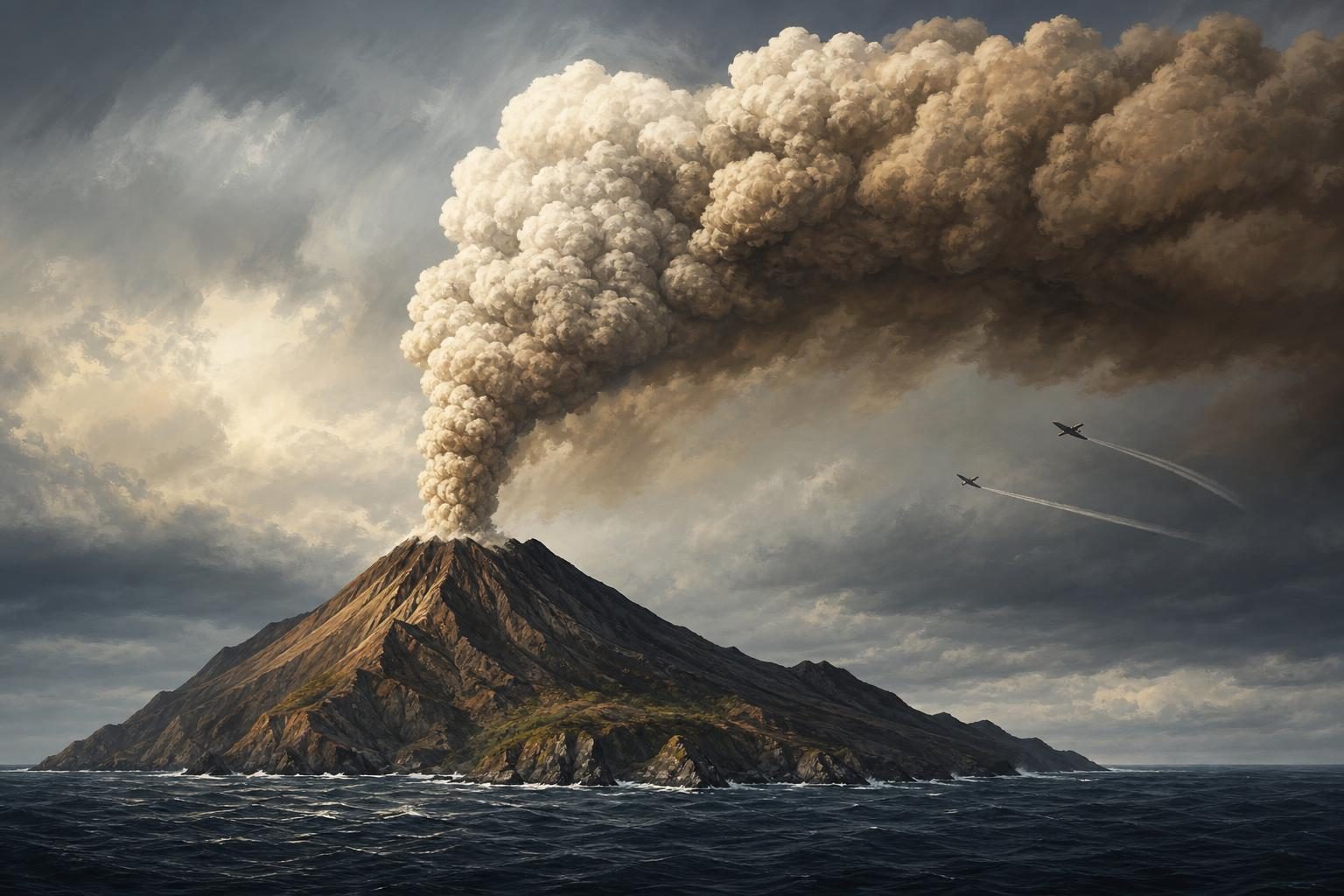
An Indonesian volcano called Anak Krakatau erupted on September 5, sending gas and ash high into the sky for more than 24 hours, according to NASA’s Earth Observatory. Anak Krakatau is a small volcano between the Indonesian islands of Java and Sumatra. Eruptions are common there, but this one was strong enough to close airports, disrupt nearly 3,000 flights, and make air quality worse in populated areas, including Jakarta, Indonesia’s capital.
That matters far beyond the volcano itself. A volcano can change a school day, a family trip, a business delivery, or a hospital visit without lava reaching anyone’s town. In this case, the main problem was ash in the air. Volcanic ash is not like soft ash from a campfire; it is gritty material blasted out during an eruption. NASA reported that the ash caused health concerns because it can irritate the respiratory tract, which is the nose, throat, and lungs, as well as the eyes and skin.
Satellites helped people see what was happening from above. NASA said images from the NASA-USGS Landsat 8 satellite showed a white plume of volcanic gas over a brown ash cloud. A plume is a column or trail of material moving through the air. Another satellite, Suomi NPP, showed volcanic material spreading over a wide area. These views matter because eruptions can be dangerous even when clouds or distance make them hard to see from the ground.
Indonesia’s meteorological agency, or weather agency, reported that ash reached up to 6,000 meters to the east of the volcano and 15,000 meters to the west by September 6. The higher number is about 50,000 feet. That is high enough to threaten airplanes, which is why officials temporarily closed eight airports on Java and Sumatra. Tiny ash particles can reduce visibility and create risks for aircraft, so stopping flights can be safer than trying to fly through uncertain air.
The eruption also shows why Earth science is not just something in a textbook. In class, volcanoes may appear in lessons about plate tectonics, the study of how huge pieces of Earth’s outer shell move. Indonesia has many volcanoes because it sits in a very active part of the planet. But the story is also about technology, public health, and decision-making. Scientists collect data. Government agencies decide what warnings to issue. Airlines and airports decide when travel is safe enough to resume.
By September 6, NASA reported, the continuous explosive eruption had slowed down. The volcano returned to a more usual pattern of Strombolian eruptions, which means intermittent bursts of ash and volcanic material instead of one long blast. Airports had reopened by September 8, but Anak Krakatau stayed at the second-highest alert level on Indonesia’s scale. An alert level is a warning system that tells people how closely to watch a hazard and what precautions may be needed.
One tricky part is that the danger did not look the same everywhere. The Indonesian Humanitarian Coordination Platform said ashfall affected areas east of the volcano, including Jakarta and other parts of West Java. It also noted that volcanic ash is different from smoke from peatland fires, which are fires in wetland soil made of partly decayed plants. Both can make breathing harder, but they move differently and require different protection choices.
For someone in middle school, the lesson is not only that volcanoes erupt. It is that natural events become community problems when they meet airports, cities, lungs, and schedules. A satellite image can become a safety decision. A science word can become a travel delay. Understanding the science helps people ask better questions when the sky changes color or an alert level rises.
Written from reporting by NASA, “Anak Krakatau Rumbles Again”.
Discussion questions
- When ash is in the air, should officials close airports early even if many flights might have been safe? Defend your answer.
- How does satellite information change who can respond to a natural hazard, compared with relying only on what people can see from the ground?
- Volcanic ash and peatland fire smoke can both hurt air quality, but they are not the same. Why is it important for leaders to know the difference?