
Free activities › Middle school
When a School Rights Office Shrinks, Families Wait
Federal changes may make it harder for families to get help when schools do not meet disability rules.
Print it — all four files
The student packet has no answers in it. The teacher copy is the same pages plus a note on each question and the answer keys. Both languages carry the same story, the same picture and the same vocabulary.
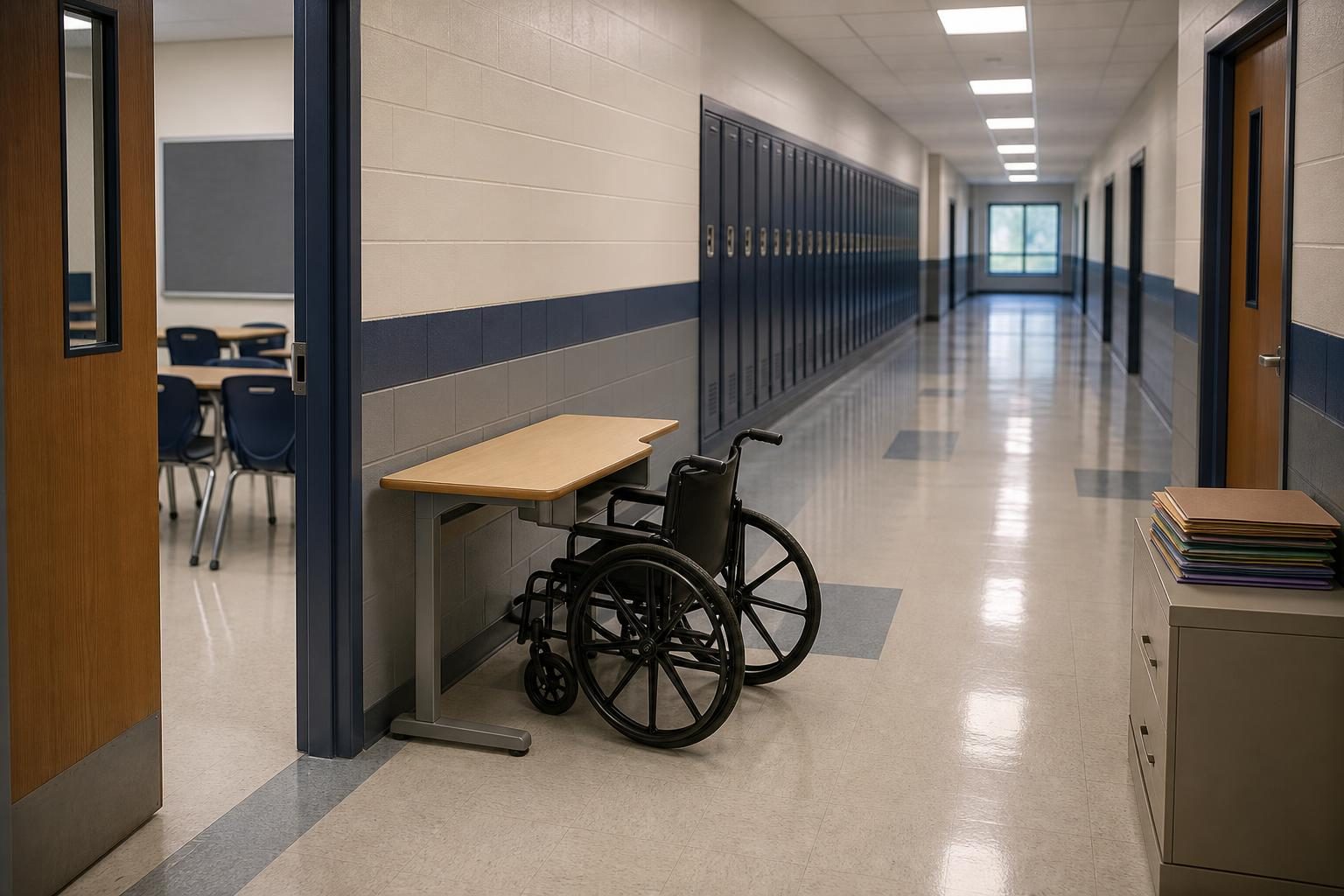
A federal office that investigates discrimination in schools has fewer workers and fewer regional offices after major cuts, and families of children with disabilities may now face longer waits when they ask for help. According to an article published by PBS NewsHour from The Conversation, the U.S. Department of Education’s Office for Civil Rights has been reorganized after staff reductions and office closures.
The Office for Civil Rights, often called OCR, is part of the federal Department of Education. It enforces civil rights laws, which are rules meant to stop unfair treatment because of race, national origin, sex, disability, age, or other protected traits. In schools, that can include checking whether a child with a disability is getting the support the law requires.
One example in the PBS article was Felicita Piñón, an eighth grader in Crowley, Texas. She has cerebral palsy, a condition that can affect movement and muscle control, and she uses a power wheelchair. Her mother said Felicita wanted to join her middle school cheerleading team in 2024, but the school was not willing to make accommodations, meaning changes that help a person with a disability take part. Her mother filed a complaint with OCR. That complaint was rejected in July 2024, before the later federal cuts, but her mother said the office still gave families a place to turn.
Families usually start close to home when a school problem comes up. They may talk with teachers, principals, district leaders, and state officials. Filing with OCR can be a last step because it connects families directly with the Education Department at no cost. The process could be slow even before the cuts, but advocates quoted in the article said families at least often received confirmation that their complaint had been received.
The changes were large. In March 2025, the Education Department cut nearly half of its workforce of almost 4,000 people. PBS reported that, according to the Government Accountability Office, an independent agency that checks how the federal government works, an estimated 299 of OCR’s 575 staff positions were included. After lawsuits challenged the cuts, some employees returned. The Education Department later reported in November 2025 that OCR had 446 staff members, including 384 who had first received termination notices.
The office also became less local. Seven of OCR’s 12 regional branches permanently closed: Atlanta, Boston, Cleveland, Chicago, Dallas, Philadelphia, and San Francisco. A regional branch is an office that serves a part of the country, so closing one can move help farther away from the people who need it.
Education Secretary Linda McMahon has said the changes were needed to improve accountability and efficiency. Accountability means being responsible for results. Efficiency means trying to get work done with less waste. In June, the Education Department announced that the Department of Justice would take a larger role in civil rights investigations.
The question for schools is not only how many complaints get filed. It is what happens when a child needs a ramp, extra help reading, a quieter testing space, or a fair chance to join an activity. Middle school is where many people first notice how rules affect daily life. A federal office may sound far away, but its decisions can shape who gets to participate in ordinary school moments.
Written from reporting by PBS NewsHour, “Civil rights enforcement cuts mean fewer staff, closed offices, longer waits for students with disabilities”.
Discussion questions
- When should a school problem be handled locally, and when should a federal office get involved?
- Do you think efficiency is a good reason to shrink a government office that protects rights? Why or why not?
- What information would you want before judging whether these changes are helping or hurting children with disabilities?