
Cargo Plane Crash Puts Airport Safety Work in Focus
A fatal runway overrun in Miami shows how many skilled jobs connect in modern air cargo.
Print it — all four files
The student packet has no answers in it. The teacher copy is the same pages plus a note on each question and the answer keys. Both languages carry the same story, the same picture and the same vocabulary.
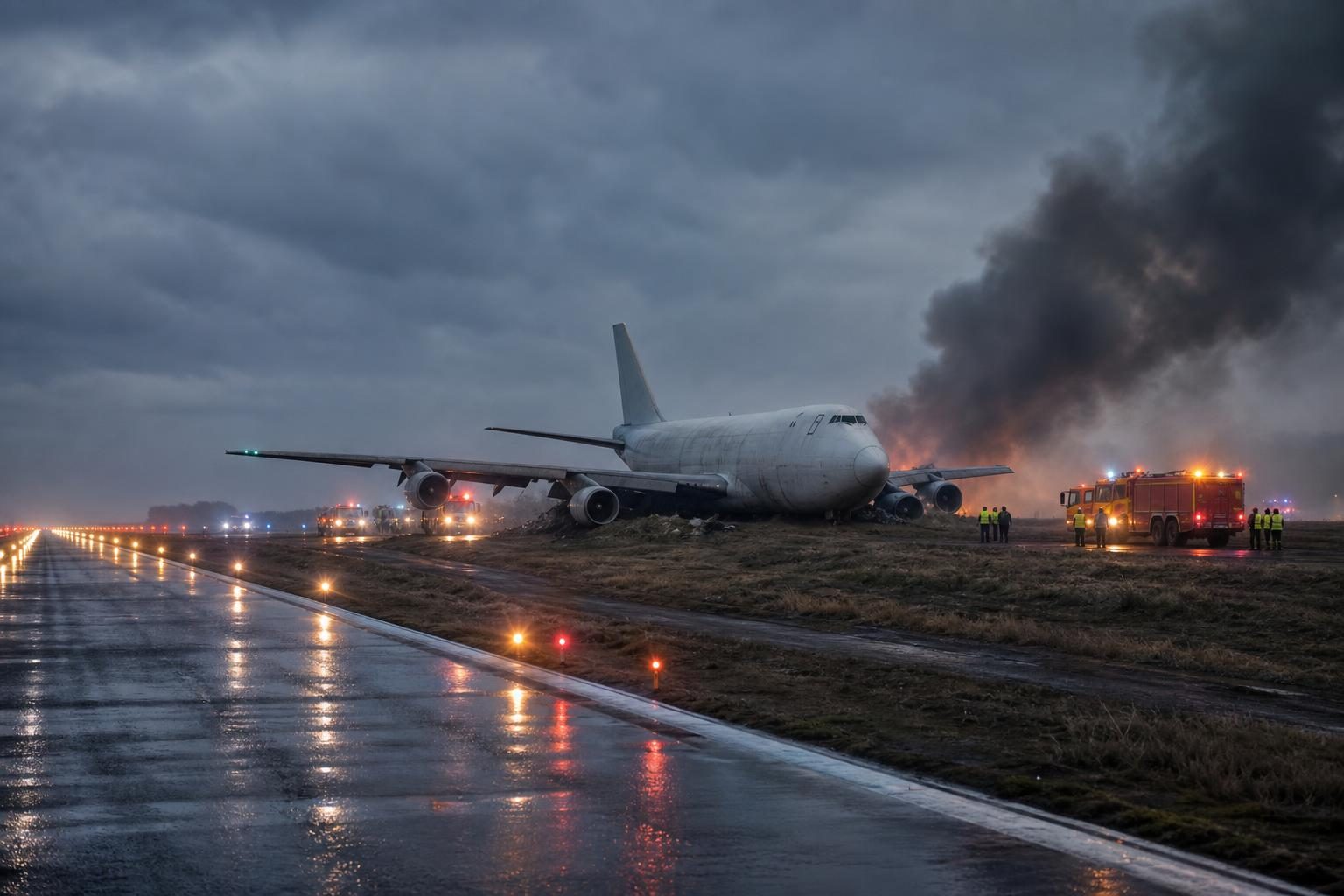
An Amazon cargo plane ran off a runway at Miami International Airport on Sunday afternoon, struck vehicles, and caught fire, killing at least five people, according to Associated Press reporting published by PBS NewsHour. Miami-Dade County officials said three people were critically injured and two others were hospitalized with less severe injuries. The crash happened around 2 p.m. after the plane arrived from San Juan, Puerto Rico. Officials said Sunday afternoon that it was still too early to say whether the people who died were on the aircraft or in the vehicles it hit.
The event matters beyond one company or one airport because air cargo is part of everyday supply chains. Packages, electronics, medicines, machine parts, and repair components often move through airports overnight or on tight schedules. When a cargo aircraft overruns a runway, meaning it cannot stop within the paved landing area, the problem immediately becomes larger than the flight crew. Firefighters, airport operations workers, medical crews, airline managers, investigators, and logistics teams all have to switch from normal workflow to emergency workflow while protecting people first.
The aircraft was described as a Prime Air plane, and the flight was operated by 21 Air, a cargo carrier based in North Carolina. A cargo carrier is an airline that moves freight instead of passengers. The plane was a 32-year-old Boeing 767 that had first been built to carry passengers and later converted to carry cargo in 2015, according to the flight-tracking site Flightradar24, which the AP cited. A converted cargo aircraft has been modified from passenger service so it can move freight instead of rows of travelers.
That detail is important for career and technical readers, but it should not be read as an explanation for the crash. The article does not say the aircraft’s age, model, maintenance history, crew actions, weather, runway condition, or cargo load caused the accident. In aviation work, guessing early can create bad decisions. A mechanic, pilot, dispatcher, firefighter, or investigator has to separate what is known from what is assumed. At this stage, the known facts are the runway overrun, the impact with vehicles, the fire, the deaths and injuries, the fuel leak, and the disruption at the airport.
Images from the scene showed the plane near a roadway beside two semi-trucks, resting on its belly and largely intact despite the fire. Resting on its belly means the aircraft was down without the normal support of its landing gear in the way it would be during an ordinary stop. Miami-Dade Rescue Fire Chief Ray Jadallah said the pilot and copilot were trapped in the cockpit, the front area where pilots control the aircraft, and that some people were trapped in cars. The agency also said another person was trapped under a vehicle. Fire crews were still dealing with a fuel leak several hours after the crash.
For emergency response workers, a fuel leak changes the job site. Jet fuel can feed fire, spread across pavement, and create hazards for rescuers and victims. Crews have to think about rescue access, fire suppression, medical triage, traffic control, and the stability of the aircraft and vehicles. Triage means sorting injured people by how urgently they need care when resources and time are limited. Those decisions are made under pressure, but they depend on training done before any sirens turn on.
The airport also had to manage the system-wide effects. Flights at Miami International were halted for much of the afternoon, and about 250 flights were delayed by late afternoon, according to FlightAware, a website that tracks flight disruptions. That is the operations side of aviation: gates, runways, ground vehicles, crews, schedules, cargo transfers, and passenger flights all depend on each other. A blocked or unsafe area does not only affect the damaged plane. It can back up work across an airport and beyond it.
The National Transportation Safety Board said it was sending a team to Miami led by Chairwoman Jennifer Homendy. The NTSB is the federal agency that investigates transportation accidents and makes safety recommendations; it is not the same as a police department or a company’s internal review team. Amazon said it would cooperate with any investigation. For people aiming at aviation maintenance, airport operations, firefighting, piloting, logistics, or safety management, the lesson is professional rather than dramatic: the work is built on procedures, documentation, communication, and the discipline to wait for evidence before deciding what happened.
Written from reporting by PBS NewsHour, “At least 5 dead after Amazon cargo plane barreled off runway at Miami airport”.
Discussion questions
- When a serious airport accident happens, how should leaders balance reopening runways quickly against preserving the scene for investigators?
- Should companies that put their brand on aircraft be judged differently from the carrier that actually operates the flight? Defend your position.
- What kinds of training or workplace habits seem most important for jobs connected to this crash, and why would employers value them?