
Warming Mountains Change the Work of Building Safely
A Nepal glacier and rock collapse shows why crews, engineers, and monitors need new skills in a warming world.
Print it — all four files
The student packet has no answers in it. The teacher copy is the same pages plus a note on each question and the answer keys. Both languages carry the same story, the same picture and the same vocabulary.
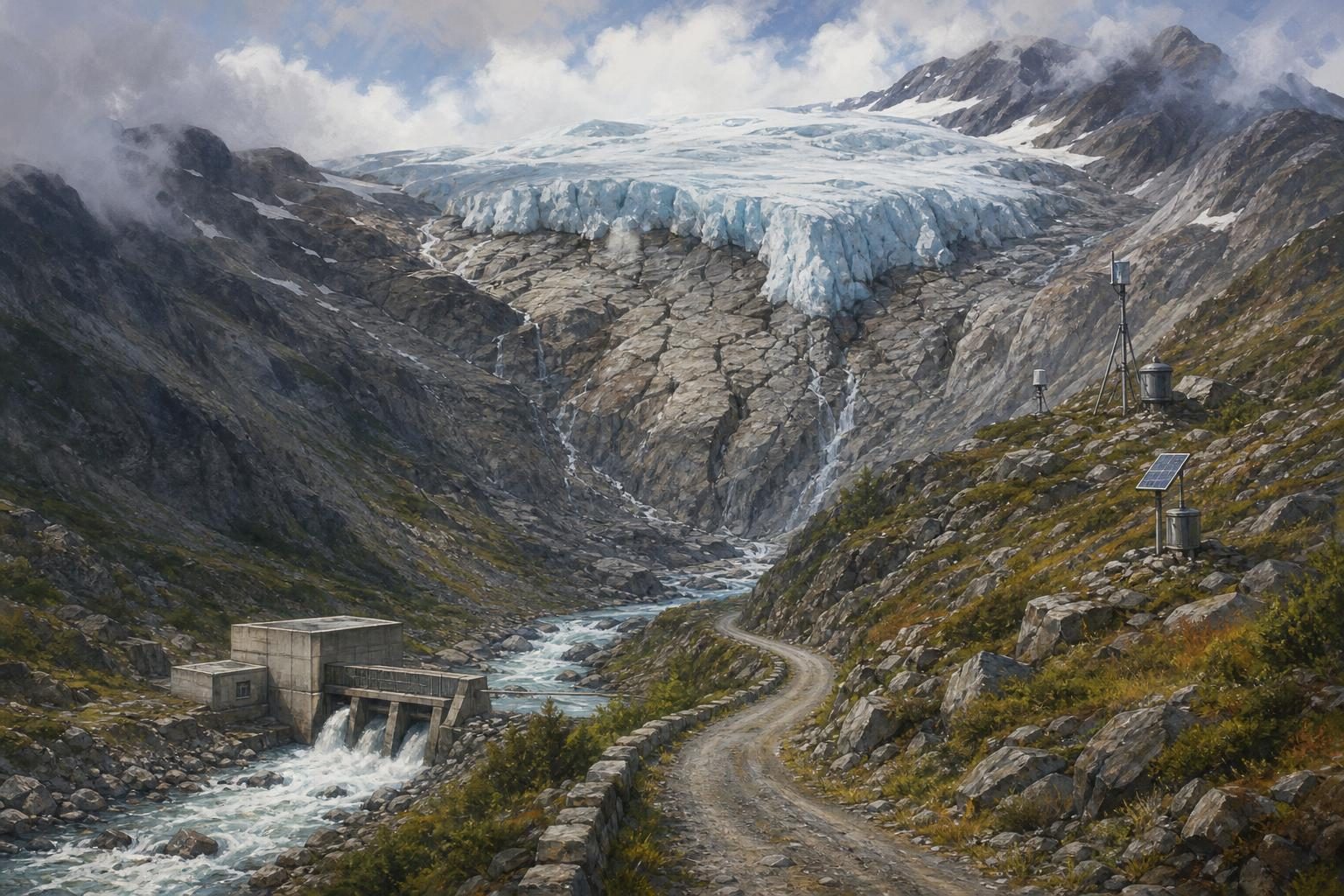
A huge section of rock and glacier collapsed in Nepal on Aug. 26, sending water, ice, boulders, and sediment down the Trishuli River corridor. More than 1,300 people were killed and more than 5,000 remain missing, with billions of dollars in damage, according to Phys.org’s report on a new analysis by World Weather Attribution.
The group’s report says human-caused climate change likely helped make the mountainside less stable over time. It does not say climate change was the only cause, or that the collapse could not have happened otherwise. The analysis also points to a large 2015 Nepal earthquake that may have weakened the rock years before the slope failed. The main finding is more practical than political: the ground, ice, and rock that crews build near are changing.
For anyone going into construction, civil engineering, energy, surveying, heavy equipment, environmental technology, or emergency management, that matters. Roads, bridges, hydropower projects, and towns in mountain valleys are often built where there is not much flat land. A river corridor may be the only route. If the slopes above that corridor become less predictable, the job is not just to build stronger structures. It is to understand the site better before, during, and after construction.
One key term in the report is permafrost, which means ground that stays frozen year-round. In high mountains, frozen ground can help hold cracked rock together, almost like a natural binder inside the slope. The report says warming has pushed the altitude where ground stays consistently frozen upward by about 100 meters, or 328 feet, per decade. That means rock at higher elevations is spending more time above freezing. As ice inside cracks thaws, the rock face under or beside a glacier can weaken.
Another key change is glacier retreat, which means a glacier is shrinking and pulling back from places it once covered. The report says glaciers in the region have been losing mass for decades at a rate equal to more than half a meter, or about 1.6 feet, of thinning each year. The Langtang Lirung glacier, in the region of the disaster, has retreated about half a kilometer, or 0.3 miles, since the 1990s. When ice pulls away, it can expose rock that had been covered for many years and remove pressure that once helped support nearby rock walls.
This changes the work of hazard assessment. A geoscientist studies Earth materials and processes, including rock, ice, slopes, and water. A geotechnical technician helps collect and test information about soil and rock so engineers can judge whether a site is safe for a road, dam, building, or tunnel. A survey or remote-sensing technician may use instruments, aircraft, satellites, or drones to measure changes in land and ice from a distance. In a warming mountain region, those workers are not just checking a site once. They may need to track changes over years.
The report says better high-altitude monitoring, earth observation, and warning systems could reduce some risks. Earth observation means gathering information about the planet from tools such as satellites, sensors, and imaging systems. High-altitude monitoring can include instruments that measure temperature, ground movement, ice loss, and water flow in places that are difficult or dangerous to reach. Installing, calibrating, powering, protecting, and repairing that equipment is skilled technical work, not just office work.
But the Nepal disaster also shows the limits of technology. A rain-caused flood may sometimes be forecast hours or days ahead. A catastrophic slope failure in a remote high mountain area can happen suddenly and move too fast for warning systems to protect everyone below. That creates hard choices for planners and builders. If a valley is the only practical route for a road or power project, avoiding all risk may be impossible. The question becomes how much risk is acceptable, who gets to decide, and what backup plans exist when a system is overwhelmed.
For hydropower work, the issue is especially important. Hydropower uses moving water to generate electricity, and projects are often located along rivers. The report notes that Himalayan valleys contain settlements, roads, hydropower projects, and other infrastructure concentrated along rivers. A project that depends on river flow also has to account for debris flow, which is a fast-moving mix of water, mud, rock, ice, and sediment. Intake structures, access roads, worker housing, and transmission routes can all be affected by what happens far uphill.
The hiring picture is changing with the hazard. Employers in these fields still need people who can read plans, operate equipment, weld, wire, survey, test materials, maintain sensors, and follow safety procedures. Increasingly, they also need workers who understand data from monitoring systems, document field conditions clearly, and communicate when something does not match the plan. A technician who notices that a slope, drainage channel, or sensor reading has changed is part of the safety system.
The larger lesson from Nepal is that climate change is not only about hotter days or stronger storms. In some places, it can affect the stability of the land itself. For the trades and technical careers that build and maintain infrastructure, that means the job site is becoming more dynamic. The best work will depend on craft skill, field judgment, and the ability to treat changing ground conditions as a central part of the job, not an afterthought.
Written from reporting by Phys.org, “Climate change made deadly Nepal glacier and rock collapse more likely, according to analysis”.
Discussion questions
- When warning systems have limits, how should communities decide whether to build or rebuild roads, power projects, and homes in a risky valley?
- Should employers in construction and infrastructure fields require more climate and hazard-monitoring training for entry-level technicians? Defend your position.
- What information would be missing if a crew judged a mountain job site only by what it looked like on the day work began?