
A 900-Year Trip for the Bayeux Tapestry
A giant stitched story from 1066 is visiting London, linking art, history, and two countries.
Print it — all four files
The student packet has no answers in it. The teacher copy is the same pages plus a note on each question and the answer keys. Both languages carry the same story, the same picture and the same vocabulary.
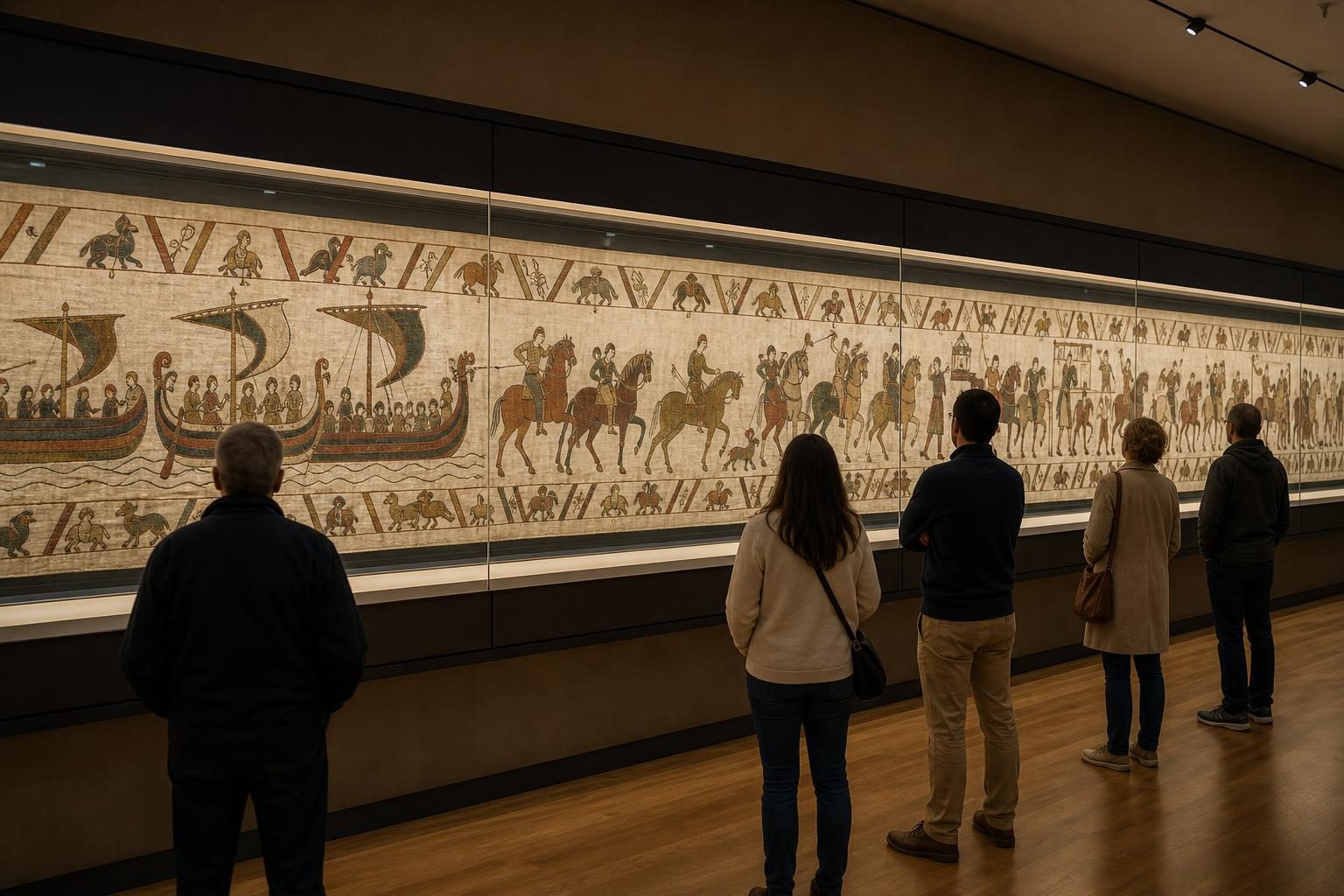
According to BBC Newsround, King Charles visited the Bayeux Tapestry before it opens at the British Museum in London next week. The Bayeux Tapestry is not a blanket for a bed. It is a nearly 70-meter-long embroidery, which is a picture made with stitches. It has not been shown in the UK for more than 900 years.
The tapestry usually lives at the Bayeux Museum in Normandy, a region in northern France. France has loaned it to the British Museum until July. A loan means the museum can show it, but must send it back. For people in London, seeing it may feel like seeing a very old, famous book come home for a visit.
The long cloth tells a story from the year 1066. That was when William, Duke of Normandy, invaded Britain. Invaded means he brought an army to take control. His army fought Harold Godwinson at the Battle of Hastings. After that battle, William became king of England. He is often called William the Conqueror.
The tapestry shows the lead-up to those events. It includes ships, meetings, kings, a comet, and many choices with big results. Imagine walking beside it in a museum. The pictures would keep going and going. Instead of turning pages, a visitor follows the story step by step along the wall.
King Charles called the tapestry a symbol of closeness between the UK and France. That matters because the cloth is about a time when people from Normandy changed England forever. Today, the same object is being shared between the two countries. One old artwork can hold a hard history and a friendly visit at the same time.
Historians, who study the past, think the tapestry was probably made in England. BBC Newsround says English women may have helped make it. Their needlework, or skill with stitching, was admired across Europe then. That detail changes how the artwork feels. It is not only about kings and armies. It may also be about careful hands doing difficult work.
For a class, the tapestry is a reminder that history can be more than dates. It can be cloth, color, thread, and pictures. It can travel. It can also ask new questions each time people look at it. Who made it? Which side does it favor? What part of the story is missing?
Written from reporting by BBC Newsround, “King Charles visits the Bayeux Tapestry ahead of new exhibition”.
Discussion questions
- Should famous old objects travel to other museums, or stay where they are usually kept? Defend your choice.
- How can one artwork be about a battle long ago and also be used as a sign of friendship today?
- If you could add one new scene to the tapestry from an ordinary person's point of view, what would it show and why?