
Free activities › Middle school
Why Bigger Dogs May Grow Old Faster
A new study looks at chemical tags on DNA to explain why huge dogs often have shorter lives than tiny ones.
Print it — all four files
The student packet has no answers in it. The teacher copy is the same pages plus a note on each question and the answer keys. Both languages carry the same story, the same picture and the same vocabulary.
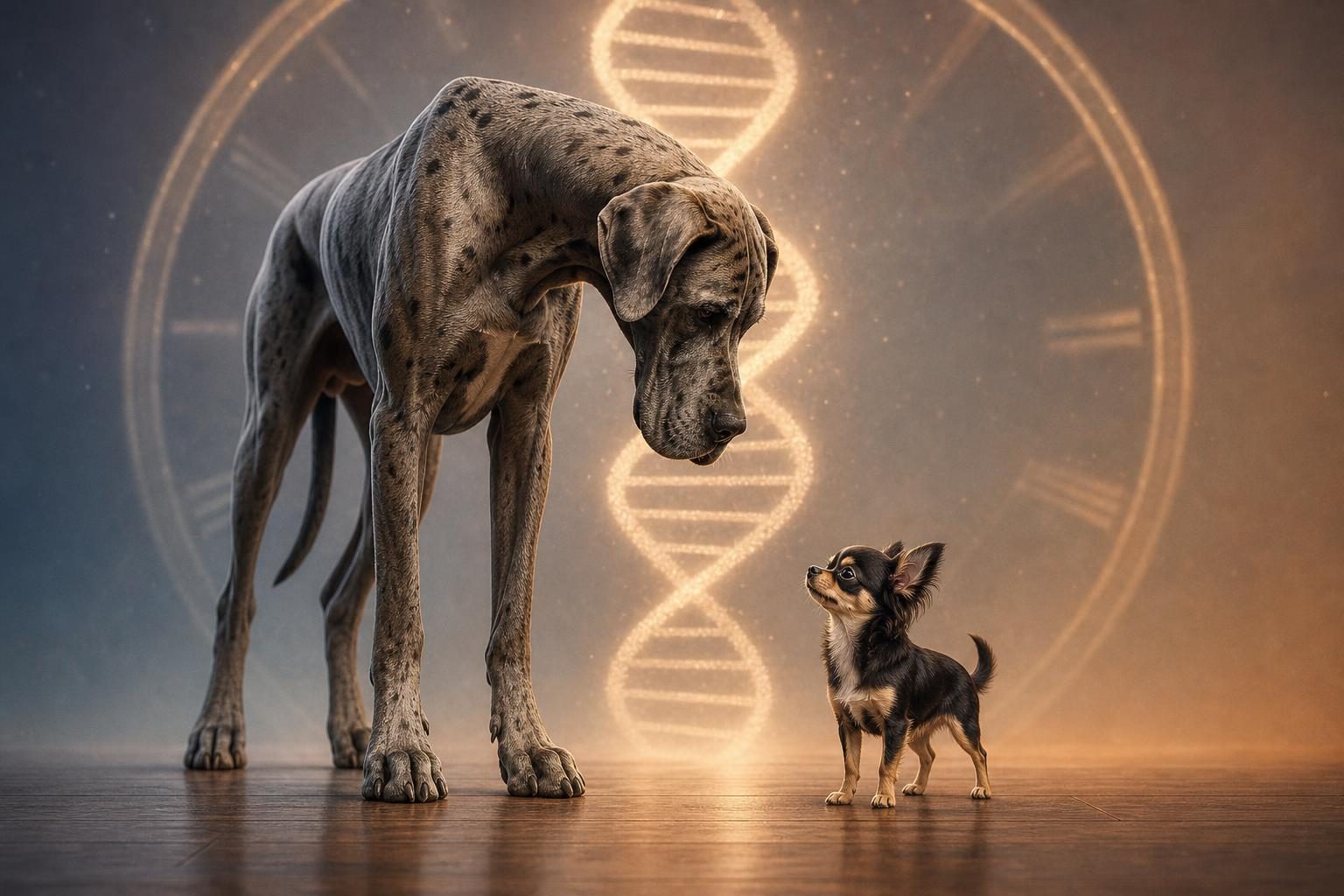
A new study may help explain why very large dogs often live shorter lives than very small dogs. According to Live Science, researchers studied chemical tags on dogs’ DNA and found signs that big dogs age faster at a deep cell level. Great Danes and mastiffs often do not live as long as Chihuahuas, and scientists have wondered why size makes such a difference.
The study was published Thursday in the journal Science. It looked at blood samples from 894 dogs in the Dog Aging Project, a long-term study based at the University of Washington. A long-term study follows subjects over time instead of checking them only once. In this case, the subjects are pet dogs whose owners help track their health and lives.
The scientists focused on DNA, the instruction molecule inside cells. They studied the methylome, which is a pattern of tiny chemical tags attached to DNA. These tags are called methyl groups. They do not change the DNA code itself. Instead, they can affect how cells use that code, a bit like sticky notes that tell a cell which instructions to read more or less often.
This kind of control is called epigenetics, which means changes that affect how genes work without changing the DNA letters. Genes are sections of DNA that carry instructions for the body. As animals get older, methyl groups tend to shift in patterns scientists can measure. Researchers can use those patterns to build an epigenetic clock, a tool that estimates biological age. Biological age means how old the body seems based on its cells, not just how many birthdays it has had.
The researchers built those clocks using dogs’ immune cells. Immune cells help protect the body from illness. Because they move through the body, they can give clues about overall health. The study found that dogs whose epigenetic age was older than expected had a higher risk of dying from any cause. When the scientists compared dogs of different sizes, larger dogs showed faster aging by this measure.
One important clue involved transposable elements, sometimes called jumping genes. These are pieces of DNA that can move around in the genome, which is the full set of genetic instructions in an organism. Methyl groups usually help keep jumping genes quiet. In larger dogs, the study found a loss of methyl groups in some of these areas. If jumping genes become too active, they may damage other genes and increase inflammation, which is the body’s swelling-and-defense response that can become harmful when it lasts too long.
The study does not prove every reason big dogs age faster. The researchers say the data explains only part of the difference. One idea is that humans bred some dogs to become very large, and that rapid growth may come with trade-offs. A trade-off means gaining one benefit while giving up something else. In this case, growing big quickly might leave less energy for long-term body repair and immune strength. The study does not directly prove that idea, but it gives scientists a path to test.
This matters beyond dogs. Dogs share homes, food environments, air, routines, and sometimes stress with people. They also get some of the same age-related diseases humans do. Learning how their cells change over time could help scientists ask better questions about human aging, too. For a middle school science class, the story connects genetics, cells, animal breeding, and data. It also shows that a familiar question, why some pets live longer than others, can lead to research at the molecular level, the level of tiny particles and chemicals inside cells.
Written from reporting by Live Science, “Big dogs age faster at an epigenetic level, new study finds”.
Discussion questions
- If people have bred some dogs to be very large, what responsibilities might breeders, owners, or kennel clubs have if large size is linked to shorter lives?
- The study used pet dogs because they share human environments. What are the strengths and limits of using dogs to learn about human aging?
- Should a biological-age test for pets be used mainly to predict health problems, or could it create unfair worries for owners? Defend your view.