
Ebola Response Hits a Workforce Bottleneck
Congo has treatment centers under construction, but not enough trained, paid health workers to run them.
Print it — all four files
The student packet has no answers in it. The teacher copy is the same pages plus a note on each question and the answer keys. Both languages carry the same story, the same picture and the same vocabulary.
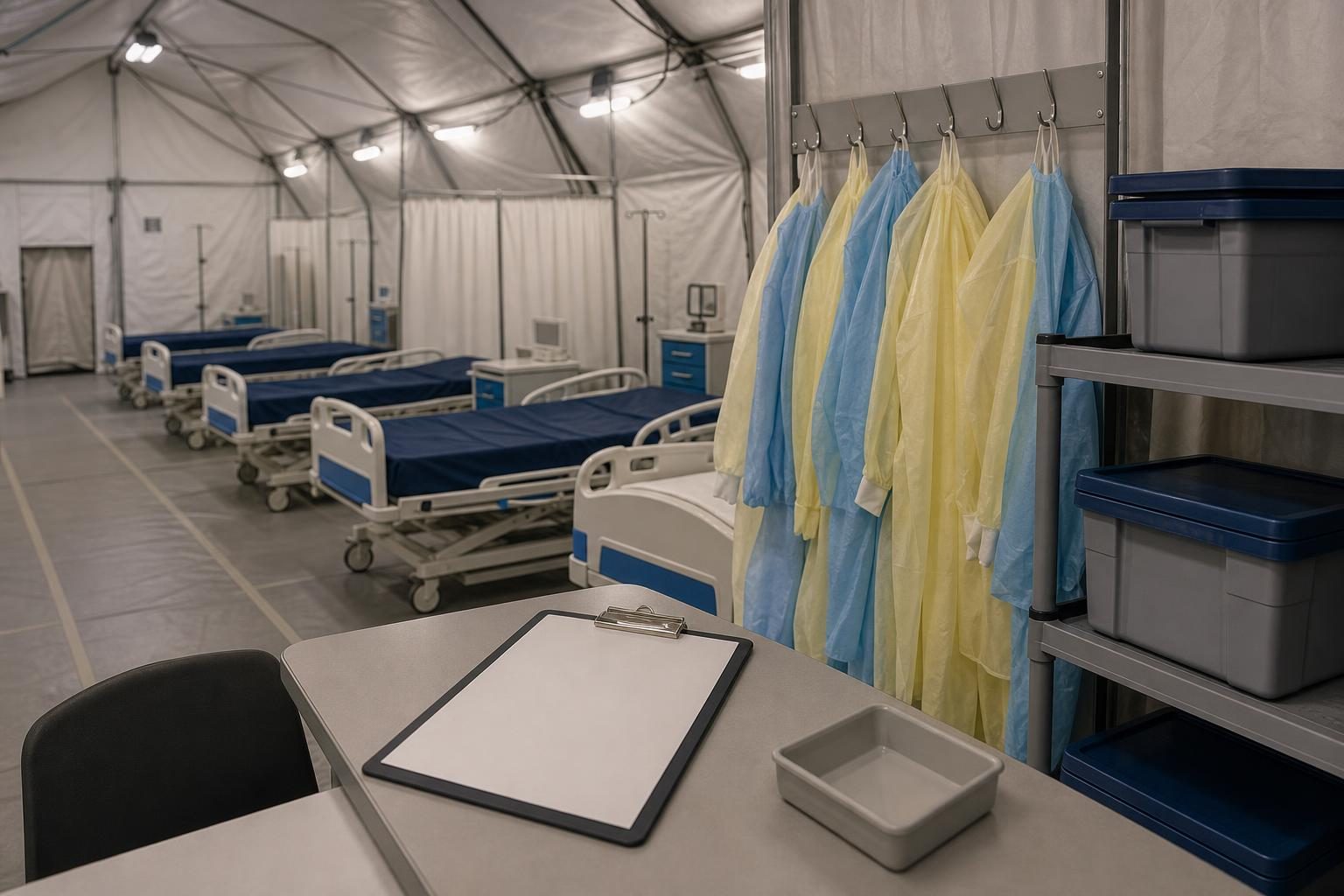
Congo is running short of health workers for Ebola treatment centers while the outbreak remains uncontrolled across a wide area. That means the problem is not only medical; it is also a staffing and operations problem. A bed that has no nurse, cleaner, clinician, or infection-control worker assigned to it is not really a working bed.
According to Associated Press reporting published by PBS NewsHour, the World Health Organization warned that Congo does not have enough health workers to staff treatment centers, especially in North Kivu, an eastern province where cases surged over a recent three-week period. The outbreak has spread to seven provinces. Government figures cited in the report list 7,773 confirmed cases and 3,759 deaths. In some places, cases are falling, including Ituri, which the report describes as the epicenter, meaning the area at the center of the outbreak. In others, the disease is still rising or difficult to contain.
For a health science or public-safety CTE pathway, the important part is the workforce chain. An Ebola treatment center is not just a building with beds. WHO representative Anne Ancia said one center needs about 300 health professionals, including anesthetists, hygienists, nurses, and general practitioners. An anesthetist is trained to provide anesthesia, the medicine and monitoring used to keep patients safe during certain procedures. A hygienist in this setting focuses on cleanliness and infection prevention, work that can include sanitation, safe handling of contaminated materials, and making sure care areas do not spread disease. A general practitioner is a physician trained to provide broad medical care rather than one narrow specialty.
The shortage is happening under difficult field conditions. The AP report says insecurity, displacement, a health workers’ strike, and heavy population movement are all making the response harder. Displacement means people have been forced to leave where they live, which can interrupt normal clinic care and make it harder to track where patients have gone. Heavy movement also changes the work for health teams: instead of serving a stable patient list in one place, they may have to adjust staffing, supplies, and outreach as people move between communities.
The labor problem is also a management problem. Catherine Smallwood, the WHO’s Ebola incident manager, said treatment beds are being added daily, but facilities still do not have enough staff and partner organizations to operate them. An incident manager is the person responsible for coordinating a response during an emergency, including people, supplies, information, and decisions. In a normal hiring market, adding capacity might mean posting jobs and waiting. In an outbreak, the timeline is compressed, and the hiring need includes people who can work safely in a high-risk clinical environment.
Pay is part of the crisis. The report says frontline workers in Ituri previously went on strike over unpaid wages, which made access to care worse. Congo’s health minister said the government was checking payroll lists after names of people not involved in the response had been added. Frontline workers said officials promised to pay back wages, but some received nothing and others only part of what they were owed. That detail matters because workforce systems depend on trust. If workers believe they may not be paid, fewer may accept dangerous assignments, and those already working may leave or stop work.
The patient mix adds another layer to the job. WHO officials said children under five have the highest case fatality rate, which means the share of confirmed patients who die from the disease. The rate for that age group is more than 60%, compared with about 40% among adults. Smallwood said it is harder to detect cases in very young children because they may not be able to describe symptoms clearly, and the symptoms can be confusing. That changes the work for clinicians and triage staff, who sort patients by urgency and likely condition. They need observation skills, communication with caregivers, and procedures that protect other patients and staff.
For anyone considering health care, emergency management, environmental services, or public health, this outbreak shows how many occupations are needed before care can happen. Nurses and doctors matter, but so do payroll staff, logistics coordinators, cleaners, data workers, supervisors, and partner organizations that keep centers operating. The hiring question is not only who has a credential. It is who can be verified, paid, scheduled, supervised, protected, and retained long enough for the system to function. In Congo’s Ebola response, the limiting factor is not only disease. It is whether the workforce can be built fast enough to match the emergency.
Written from reporting by PBS NewsHour, “Congo faces health worker shortage as Ebola remains out of control, WHO says”.
Discussion questions
- If a treatment center can add beds faster than it can add trained staff, should leaders keep expanding physical capacity or slow construction until staffing is secured? Defend your position.
- How should an emergency health response balance fast hiring with the need to verify payroll and prevent people who are not working from being paid?
- What lessons from this Ebola staffing shortage could apply to a local disaster response in the United States, such as a flood, wildfire, or mass shelter operation?