
A Ten-Sided Shape Is Growing in Saturn’s Clouds
Hubble is helping scientists watch a new wind pattern form near the ringed planet’s south pole.
Print it — all four files
The student packet has no answers in it. The teacher copy is the same pages plus a note on each question and the answer keys. Both languages carry the same story, the same picture and the same vocabulary.
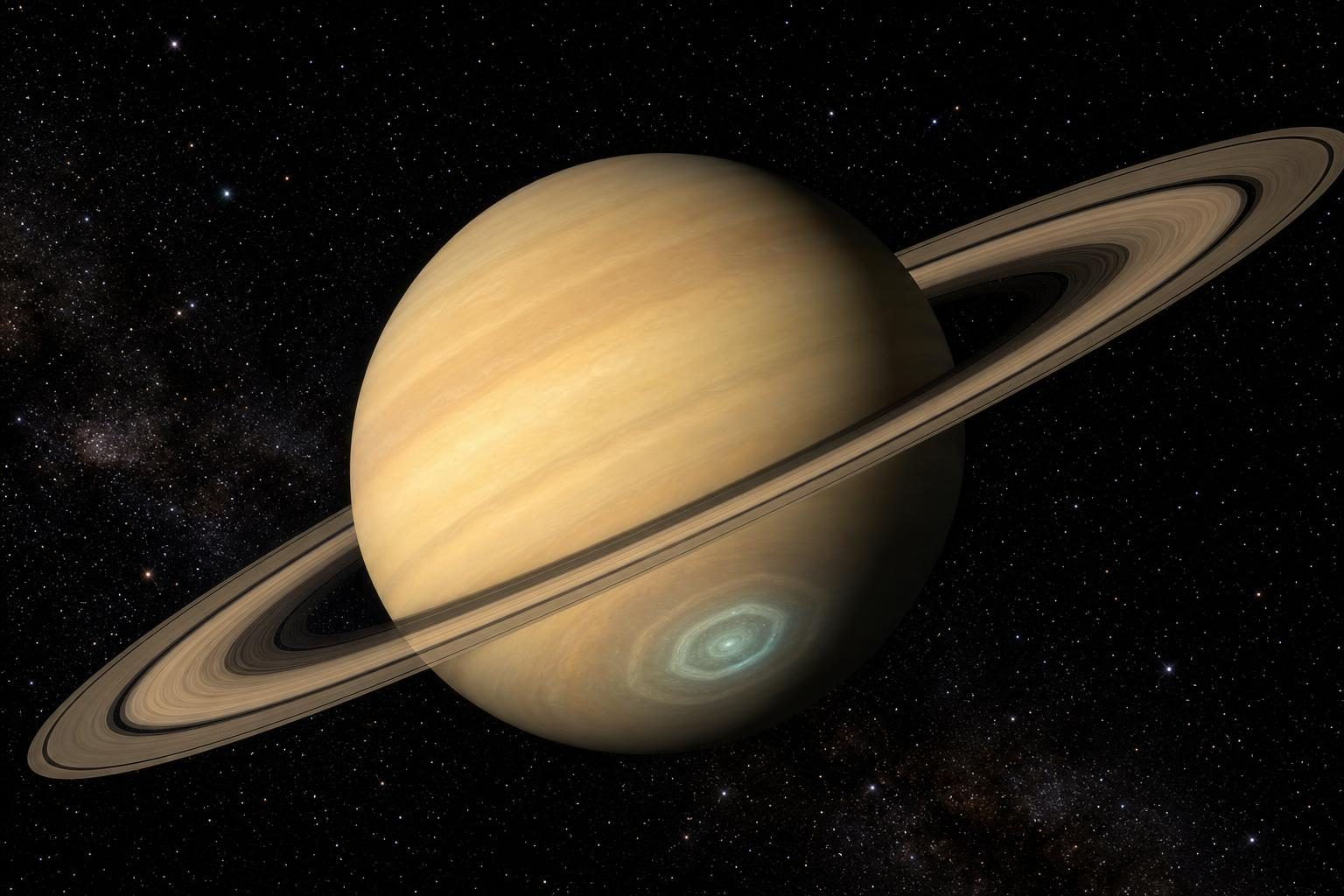
NASA’s Hubble Space Telescope has spotted a strange shape around Saturn’s south pole. It looks like a decagon, a shape with ten sides. According to reporting by Live Science, scientists think the pattern began forming in 2023 and is getting stronger.
Saturn is the giant planet with bright rings. No one could stand on it like a playground. It is a gas giant, which means it is mostly made of gases. Its weather happens in thick layers of clouds and wind. From far away, those winds can make patterns big enough for telescopes to see.
The new shape is an atmospheric wave. That means air is moving in a repeating pattern, a little like ripples in water. It sits inside a jet stream, which is a fast river of wind. On Earth, jet streams help move storms. On Saturn, they can circle the planet for a very long time.
This discovery matters because Saturn already has one famous puzzle. At its north pole, scientists have watched a six-sided shape, called a hexagon, for more than 40 years. Now they may be watching a ten-sided pattern grow at the other end of the planet. That is rare. Usually, scientists see a finished pattern and wonder how it started.
Right now, Saturn’s south pole is turned toward Earth enough for a good look. Saturn takes about 29 Earth years to go around the sun. As it moves, we get better views of different parts of the planet.
Hubble was not the first telescope to notice something odd. Observatories on the ground saw a wavy band near Saturn’s south pole in 2024. More images in 2025 showed the band becoming more like a decagon. Hubble can see more clearly because it is above Earth’s air. Earth’s air can blur telescope pictures, even on a clear night.
Scientists still do not know why the shape formed now. NASA’s Cassini spacecraft orbited Saturn from 2004 to 2017. It did not see this pattern. That makes researchers think the decagon is new, at least in recent Saturn history.
More observations are planned with Hubble and the James Webb Space Telescope. Scientists will compare pictures over time. If the shape grows, fades, or changes sides, each clue can teach them how giant planets move air. It may also help them understand why worlds can have weather that looks almost like geometry.
Written from reporting by Live Science, “Hubble spots a mysterious 10-sided 'decagon' growing around Saturn's south pole”.
Discussion questions
- If you could choose what a space telescope studies next, would you keep watching Saturn or look for something new? Defend your choice.
- In what ways is Saturn's decagon like weather on Earth, and in what ways is it very different?
- Scientists do not yet know why the decagon formed now. What kind of evidence would make one explanation more convincing?