
Free activities › Middle school
What Should Kids Know Before Talking to AI?
Experts say young children need help telling the difference between a helpful machine and a real human relationship.
Print it — all four files
The student packet has no answers in it. The teacher copy is the same pages plus a note on each question and the answer keys. Both languages carry the same story, the same picture and the same vocabulary.
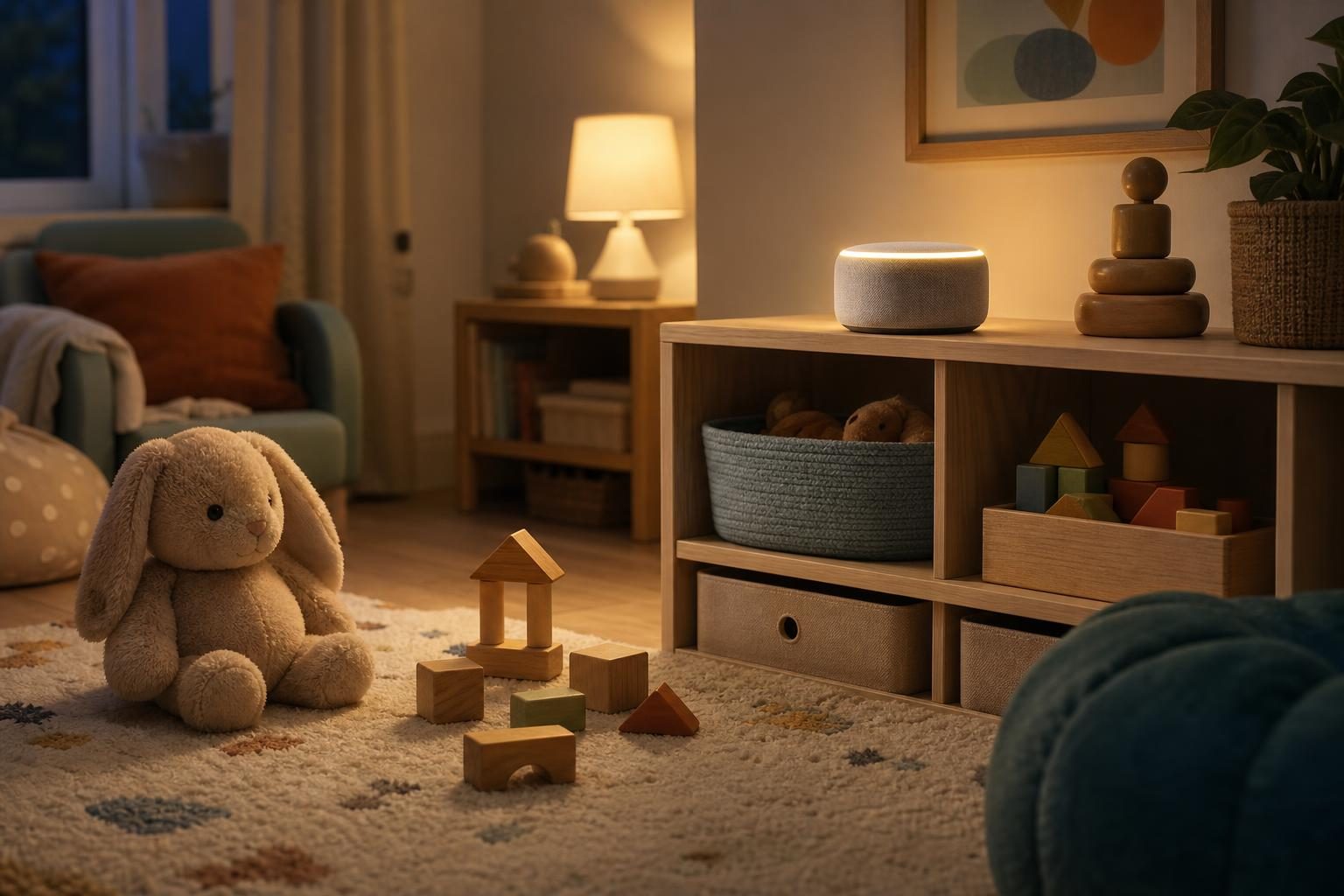
Experts are urging parents and caregivers to talk with young children about artificial intelligence, according to reporting by PBS NewsHour. Artificial intelligence, or AI, is computer technology that can do tasks that seem to require thinking, such as answering questions, making images, or writing sentences. The experts said even very young children are already meeting AI at home, in child care, and at school.
That can happen through a smart assistant, which is a voice-controlled computer program such as Siri or Alexa. It can also happen through generative AI, which is AI that creates new text, pictures, sounds, or videos. A child may hear a smart speaker answer a question or see AI-made content while watching videos online.
The story focused mostly on children younger than 8, because a lot of brain development happens in those years. But it matters for middle school, too. Many sixth, seventh, and eighth graders have younger siblings, cousins, or neighbors who use technology. Middle schoolers are also old enough to understand the bigger question: when should a machine be treated as a tool, and when might it start to feel too much like a person?
Researchers told PBS that young children can learn from technology by preschool age. But research on young children and AI is still developing. That means adults do not yet have all the answers about how AI affects learning, imagination, trust, or friendship. One expert said AI learning tutors can be useful, but personal AI at home is still new enough that researchers are learning as they go.
One main concern is that young children may think a friendly voice belongs to a real person. Dr. Jenny Radesky, a doctor who studies child development and behavior, said children can be “magical thinkers,” meaning they may believe ordinary things have human-like powers or feelings. Because of that, experts suggest explaining that a device may sound friendly, but it does not have a body, feelings, or real-life experiences.
Experts also said adults can compare a computer answer with a human answer. For example, if a smart speaker gives information, a parent might also ask another adult what they think. That helps a child see that people and machines are different sources of information. A machine can answer quickly, but it does not understand the world the way a person does.
AI toys raise another set of questions. Common Sense Media, a group that studies media and technology for families, advised keeping AI toys away from children age 5 and younger and being extremely careful about buying them for children ages 6 to 12. The group tested three AI companion toys and found that 27 percent of the toys’ responses were not appropriate for children because they were too mature, confusing, or scary.
The experts also pointed to privacy risks. Privacy means control over personal information, such as what someone says, likes, or does. An AI toy may collect data, which means pieces of information stored by a company or device. Experts worry that young children cannot fully understand what they are sharing.
There is also a play issue. A stuffed animal or block does not answer back, so a child has to invent the story. An AI toy can respond at any time and may always seem agreeable. Some experts worry that this could make real relationships feel harder, because real people say no, get tired, and have their own needs.
The larger lesson connects to science, health, and civics. New technology is not just about what a tool can do. It is also about evidence, responsibility, and choices. AI can help people learn, but it can also be wrong, collect information, or seem more human than it is. Knowing the difference is becoming part of growing up with technology.
Written from reporting by PBS NewsHour, “Helpful or harmful? When it comes to AI and young kids, experts have these tips for parents”.
Discussion questions
- Should families treat AI toys differently from ordinary toys, or should the same rules about screen time and safety be enough? Defend your position.
- If a young child trusts an AI answer more than an adult's answer, what should the adult do: limit the technology, teach the child how it works, or both?
- What information would you still want before deciding whether AI is helpful or harmful for young children?